


Introduction
High standards of ethics and conduct underpin local democracy, they build trust, support good governance, help improve decision making and lead to better outcomes for residents. Ethical behaviour means applying moral principles like honesty, selflessness and integrity to daily professional decisions and interactions. It guides how members and officers treat one another, handle resources, and respect stakeholders.
Ethics and standards apply to every member and is a strong pillar of governance in itself. All these standards and practices are equally relevant to scrutiny work, and how you conduct your scrutiny business, and yourself within the standards frameworks will mean that your scrutiny is driving accountability, transparency and working in the interests of your residents.
This practice guide addresses ethics within the framework of codes of conduct related to your council work, it should not be confused with matters of personal belief or individual morality.
What do we mean by ethics?
Ethics is an important subject within local government. This guide includes information and some self-reflection ideas to help whilst you go about your council business.
In thinking about ethics, we can consider our intentions, actions and how they impact on others. We can ask ourselves, are we acting ethically by checking against several well understood values:
- Am I behaving with honesty and integrity: do I communicate truthfully, avoiding deceit and keeping my commitments?
- Am I accountable: do I accept personal responsibility for my decisions and mistakes and fix them, rather than shifting blame?
- Am I fair and respectful: do I treat everyone (fellow members, officers, citizens and stakeholders) equitably regardless of background, position, or personal ties?
- Can I be trusted to maintain confidentiality: by not disclosing sensitive information or data, and personal information? (Although there may be certain circumstances e.g. safeguarding where disclosure may be appropriate. Always seek guidance from the relevant data officer)
- Am I transparent in my actions, behaviours and words: the rationale for my decisions and policies to build trust?
Ethics in local government are important to build and maintain trust with citizens and safeguard against decisions or actions that are taken for personal gain. Scope of personal gain includes benefits gained directly by the individual or indirectly through family members, friends, associates or connected organisations.
Public trust in politicians has decreased over recent decades and it is therefore even more vital that members and officers maintain and model high standards of ethical behaviour and deal promptly with misconduct.
This guide is designed to assist councillors understand their part in maintaining high standards of behaviour and decision making. When conducting scrutiny business you are looking for transparency and accountability, so keeping the standards and ethics frameworks front of mind is important.
The Seven Principles of Public Life (‘Nolan Principles’)
The Nolan Principles apply to anyone who holds a public office. This includes anyone elected (including councillors) or appointed (including officers) to public office, nationally and locally, as well as those in other sectors delivering public services.
Every council constitution contains a code of conduct, which sets out things such as ethical codes, frameworks and protocols. Most codes of conduct will lead back to or reference the Nolan Principles. Most codes will set out expectations of behaviour such as, treating everyone with respect, guidelines to prevent bullying and harassment and maintaining confidentiality. Check your own code of conduct for details.
The Nolan Principles
- Selflessness — act in the public interest, not for personal or family gain.
- Integrity — avoid obligations to people or organisations that might seek to influence you.
- Objectivity — base decisions on merit, not favouritism.
- Accountability — submit to whatever scrutiny is appropriate to your role.
- Openness — act and take decisions transparently; give reasons.
- Honesty — declare any private interest and resolve conflicts promptly.
- Leadership — exhibit and promote these principles through your own behaviour.
The legal and governance framework
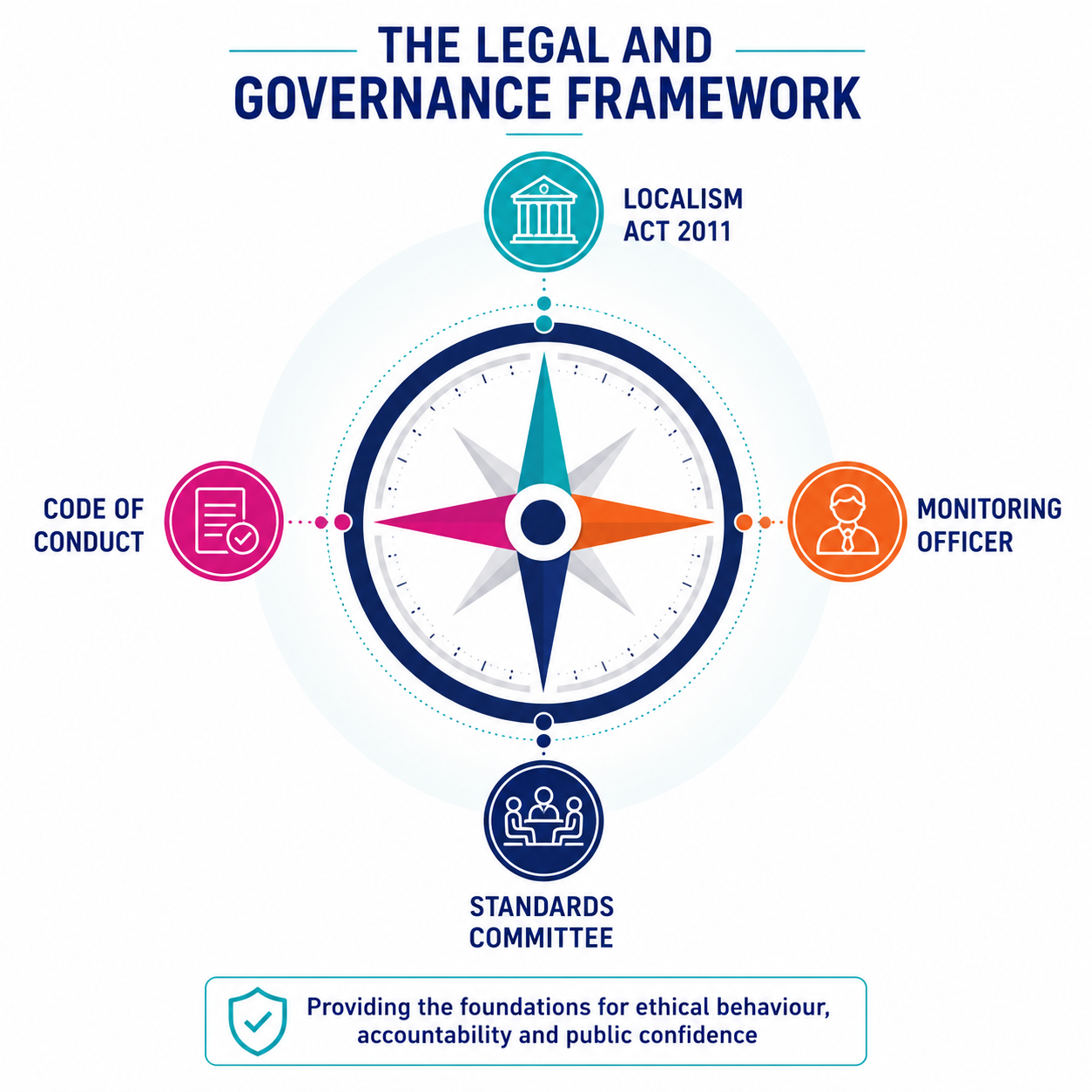
Localism Act 2011
Requires every council to adopt a Code of Conduct, and maintain a register of interests
Monitoring officer
- Your first point of contact for advice – ask before you act
- One of their many responsibilities is to promote high ethical standards for all, and ensure elected members are familiar with the code of conduct
Model code of conduct
Many council codes are based on the 2020 LGA regularly reviewed publication:
Local Government Association Model Councillor Code of Conduct 2020 Always check your own council’s version as details do vary.
Standards committee
It is anticipated that all local authorities will soon be required to set up a standards committee to consider any complaints against a member’s behaviour
- Has been optional since the 2011 localism act
- The majority of councils maintain standards committees, some have merged them with audit
- Roles include, investigating or handling complaints about rule-breaking, and overseeing the code of conduct and member training on standards and behaviour.
Reform is on the way
Government has committed to a new national code of conduct which is expected to be mandatory, with new powers for serious breaches. As no firm dates have been released yet, check with your Monitoring Officer for the latest position.
Declaring interests
Declaring interests means that a councillor must publicly state any personal business or financial ties that could conflict with official council work. It’s important because transparency ensures local decisions remain fair and free from potential personal gain or bias.
It matters because
- Public trust – demonstrates decisions are made for the local community not personal benefit
- Legal Duty – adheres to the law and code of conduct
- Fairness – prevents members voting where they have an interest
What should be declared?
Disclosable Pecuniary Interests (DPI’s) – means an interest of yourself, or your partner, if you are aware, which are described in your constitution. They will be things like:
- Employment
- Land/Licences in the authority or ward
- Sponsorship monies you may have received
Corporate shareholdings in a company within the authority above the set threshold £25,000 or one % of the total issued share capital.
Check out the LGA guidance for details of this and non-pecuniary interests:
Declare a DPI at a meeting as soon as it becomes relevant, then you will usually be asked to leave whilst the item is discussed. Many codes also require the declaration of personal interests (e.g. a close friend of relative who might be affected by the decision).
If you are unsure, declare it – it is never wrong to over declare. Seek advice from your Monitoring Officer.
Check the government document for more details
Disclosable Pecuniary Interests
Gifts, hospitality and everyday conduct
Register everything over your council’s threshold (usually between £25- £50) even if you declined it – if you’re in doubt about your council’s threshold, consult your code of conduct.
Treat the public, councillors, officers partners and stakeholders with civility, even (or especially) if you have a political disagreement.
Will not be tolerated of anyone you come into contact within the course of your council work, including outside meetings.
the same standards of behaviour apply online as they do in meetings and face to face interactions. This applies to both official council accounts and personal social media accounts when engaging in matters related to your role as a councillor.
Ethics when using information and council resources
Exempt information
Never disclose confidential or exempt reports, information or recount discussions from closed sessions. This is treated as a breach of the local code of conduct and can trigger a formal standards complaint. There is the potential for removal from committees or political groups if the complaint is upheld.
Example
Sharing the contents of a confidential report with a residents’ group before it is published, so they can campaign against a proposal
Council resources
Public funds, staff and equipment must remain politically neutral. Never attempt to use them to promote your political party or to campaign.
Example
Asking a council officer to research local crime, housing or school performance data for inclusion in a party-political leaflet
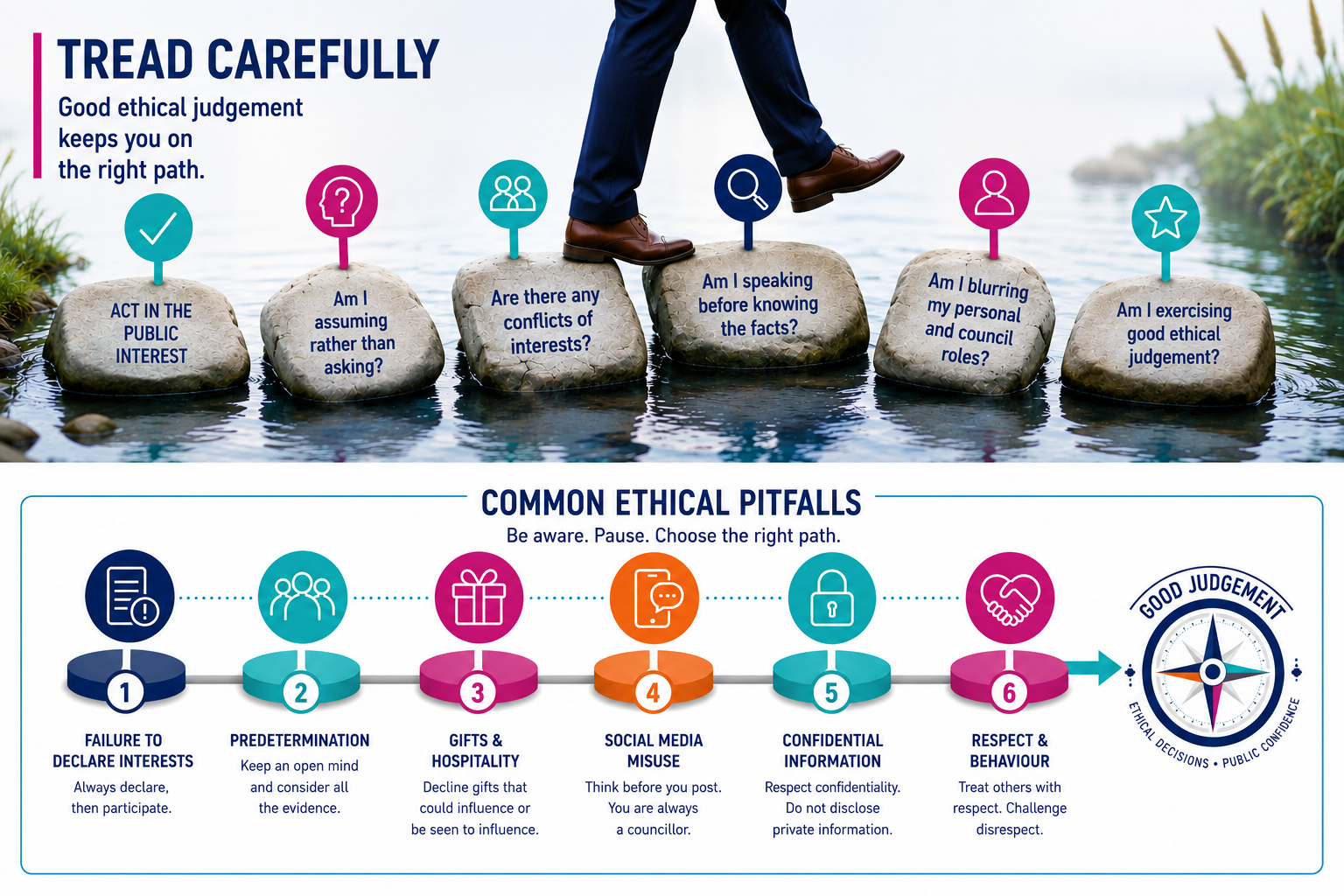
Think before you act
- If you think you might have an interest to declare before a vote or discussion, declare it. Let the Monitoring Officer decide if it’s valid rather than risk a code of conduct breach
- Gifts can come in ways you don’t expect, a vintage bottle of wine, concert tickets, or a nice dinner out. Always seek advice.
- Beware of sharing items on social media
- Don’t publicly commit to a decision before hearing evidence, having a view is fine but you should always have an open mind
- It is unacceptable to use your position or imply council authority or advance a personal, business or campaign interest
Common pitfalls
If you’re unsure and want help
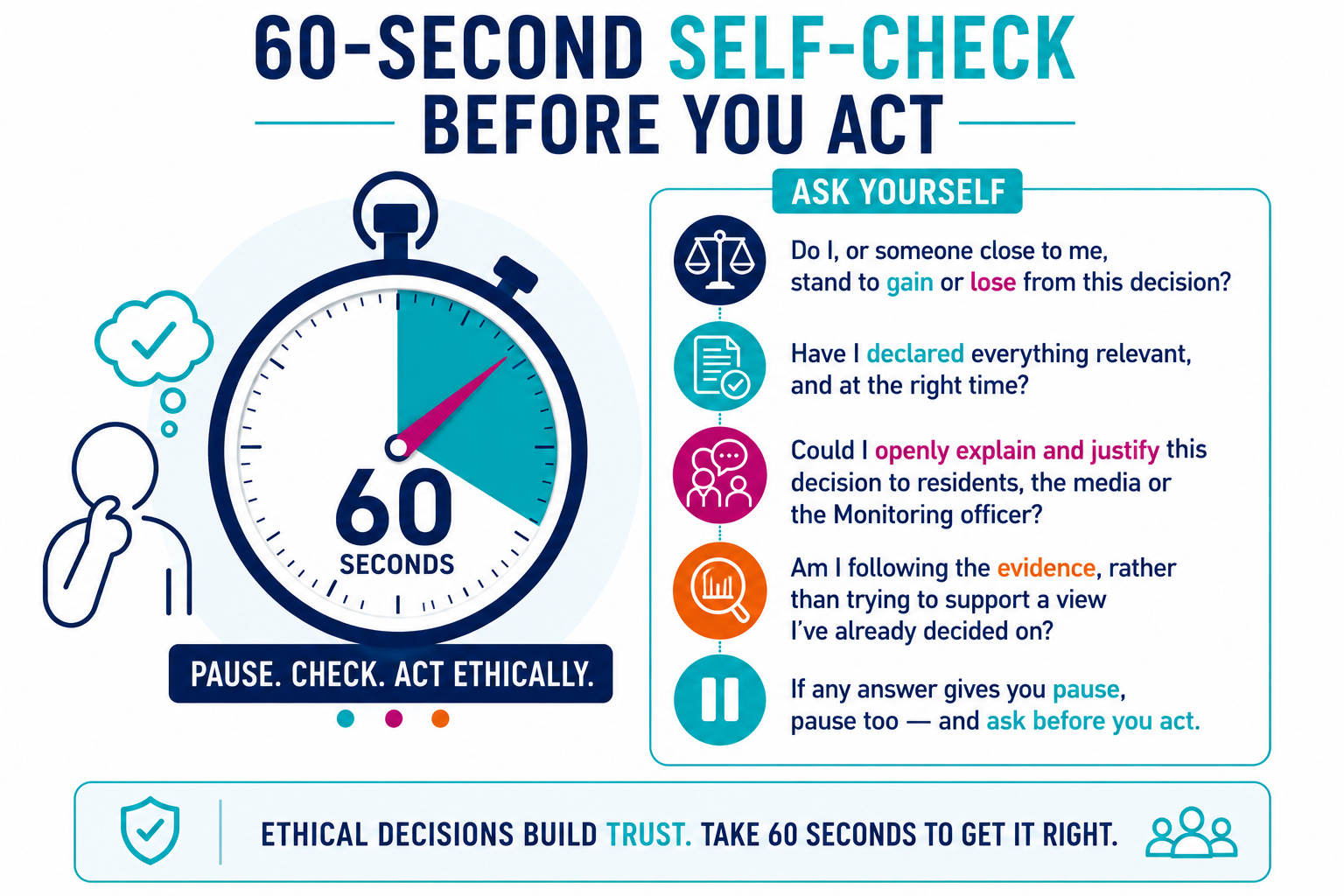
If you’re unsure
Ask first – Contact your Monitoring Officer before the meeting or decision
‘Front page’ test – would this stand up to public scrutiny if it was reported by the media tomorrow?
Declare early – this protects you and the council’s reputation
Keep a record – if you asked for advice keep a note of what, when and by whom that advice was provided, in case it’s questioned later
Where to go for help
Your Monitoring Officer – statutory advisor on conduct and interests
Democratic/Legal Services – for procedural and meeting specific queries
LGA Guidance – LGA Model Councillor Code of Conduct
CfGS website– CfGS resources
Your Standards Committee – contact the chair
 All resources