


Introduction
Teignbridge District Council has been on a long journey to strengthen its governance arrangements, overview and scrutiny function, and member development offer.
One year on from receiving a range of support, we caught up with Charlie Fisher, Monitoring Officer and Democratic Services Manager, to reflect on the progress made, the challenges encountered, and significant lessons along the way.
Charlie describes the work not as a series of separate projects, but as part of a wider culture of continuous improvement. Through a combination of external support, organisational commitment and a willingness to test new ideas, Teignbridge has been developing a more purposeful and impactful approach to scrutiny—and one that is increasingly focused on outcomes, community engagement and making a tangible difference.
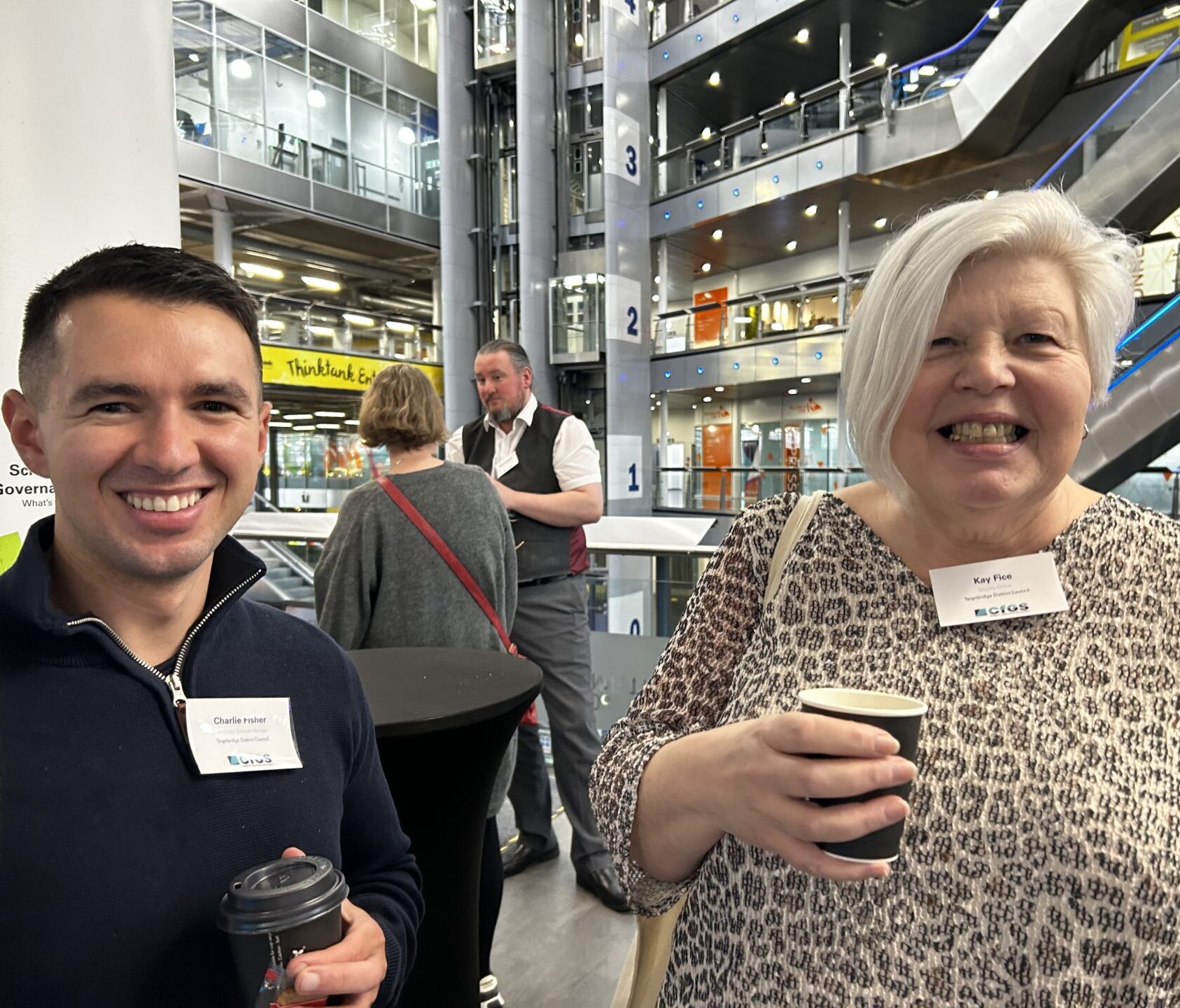
Charlie is pictured with Kay Fice, Scrutiny Officer at Teignbridge District Council
Background and context
Following a governance review in 2021, Teignbridge District Council undertook a programme of improvement work focused on governance arrangements, member roles and responsibilities, and the effectiveness of overview and scrutiny.
The work was revisited in 2024 through a rapid review which considered progress against previous recommendations and identified further opportunities to strengthen governance practices. Alongside this, the council introduced training, informal mechanisms for communication, and new ways of engaging with communities.
The focus has been on helping members become clearer about their role, purpose and impact, while ensuring scrutiny activities lead to meaningful outcomes rather than simply discussion.
From Charlie Fisher’s perspective, the improvement journey cannot be separated into individual projects. Instead, it has been a continuous process of development:
Challenges and opportunities
One of the key challenges has been ensuring that members move from understanding scrutiny principles in training sessions to applying them consistently in committee meetings.
While training has helped members become more knowledgeable and confident, there remains a challenge in encouraging all members to proactively contribute ideas, particularly around work programming.
Another challenge is maintaining momentum during a period of Local Government Reorganisation (LGR), with concerns about officer capacity and member engagement as organisational changes progress.
At the same time, Teignbridge has identified significant opportunities to strengthen scrutiny further. These include:
- Earlier and more meaningful involvement in budget scrutiny.
- Increased community engagement in scrutiny processes.
- Greater use of informal meetings to support effective decision-making.
- Using technology and AI tools to improve member preparation and questioning.
- Building stronger links between scrutiny, executive members, and wider governance arrangements.
Initiatives and actions taken
Embedding a focus on impact
A key theme throughout the council’s development work has been encouraging members to focus on outcomes and impact.
Training sessions have challenged members to consider:
“Why are you here? What’s the point in being here? What are you doing?”
Members are increasingly considering what recommendations should result from scrutiny discussions rather than treating meetings as opportunities for discussion alone.
Developing formal and informal scrutiny spaces
Drawing on CfGS learning, the council has introduced a blend of formal committee meetings and informal sessions.
The informal meetings provide a space for exploratory conversations, work programming and development discussions that may not be suited to formal committee settings.
Even room layouts have been deliberately redesigned to reinforce different behaviours:
- Formal meetings use a traditional committee-style arrangement.
- Informal meetings are arranged as a boardroom-style table with everyone sitting together.
This simple change helps reinforce the purpose of each meeting and encourages more collaborative discussions.
Community-based scrutiny
One of the most significant developments came through a call-in meeting concerning a local swimming pool decision.
When council offices became unavailable shortly before the meeting, the scrutiny committee relocated into the affected community. Approximately 30 members of the public attended and around 12 contributed directly to the discussion.
The meeting room was arranged so that councillors faced the public rather than having residents seated behind them. Standing orders were suspended to allow public participation.
The experience had a lasting impact.
“It will probably be the legacy of this Term”
Members consistently refer back to the meeting as an example of scrutiny making a visible difference to local communities.
Strengthening member preparation
The council has introduced several approaches to help members prepare more effectively for meetings:
- Pre-committee briefing sessions.
- Structured discussion around questioning strategies.
- Drafting potential recommendations before meetings.
- Member workbooks that help councillors record questions, recommendations and actions.
Charlie describes these workbooks as practical tools that guide members through the scrutiny process and help build confidence and consistency.
Using technology and innovation
The council has also experimented with using Microsoft Copilot to review reports before meetings.
AI-generated questions are used to stimulate member thinking and identify issues that may require scrutiny.
According to Charlie, the questions generated are often highly relevant and have helped members engage with reports in new ways.
Strengthening work programming
Work programming has become a more deliberate and evidence-based process.
Initiatives include:
- Dedicated work programme sessions.
- Use of performance and management information.
- Public surveys to gather topic suggestions.
- Exploration of engagement with town and parish councils.
- A stronger focus on capturing impact through annual reporting.
Outcomes and impact
While Charlie is cautious about attributing improvements to any single intervention, he believes overview and scrutiny has developed significantly over the last two years.
Key impacts include:
- Greater member understanding of their scrutiny role.
- Increased focus on recommendations and outcomes.
- More effective scrutiny discussions.
- Stronger community engagement.
- Better preparation for meetings.
- Improved confidence amongst scrutiny members.
The community-based call-in meeting stands out as a particularly significant achievement, demonstrating how scrutiny can connect directly with residents and increase public confidence in local decision-making.
The introduction of informal meetings, workbooks and structured preparation has also helped create a culture of continuous improvement rather than one-off change.
Top tips
Based on Teignbridge’s experience, Charlie’s advice for other councils would be:
Keep trialling new approaches
Reflect after every meeting.
“What worked? What didn’t? How can we improve?”
If something works, build on it. If it doesn’t, learn from it and move on.
Make scrutiny practical
Provide members with tools and frameworks that help them participate effectively.
Sometimes a simple workbook can help members focus their thinking and improve outcomes.
Ask members for feedback
Regular self-assessment and reflection provide valuable insight into what is working and where further improvement is needed.
Think about the whole governance system
Overview and scrutiny improvement should be connected to member development, executive-member relationships and wider governance arrangements.
“You can’t solve one thing at a time.”
Lessons learned
Several important lessons have emerged from Teignbridge’s journey.
One of Charlie’s strongest reflections is that meaningful change can happen more quickly than organisations sometimes expect.
“You can make change if you just grab it and go.”
The same messages about expectations, roles and behaviours need to be reinforced across scrutiny, executive functions and member development.
Continuous improvement comes from regular review and refinement rather than large-scale transformation programmes.
Having the freedom to test ideas and introduce improvements has enabled innovation and progress.
Not every idea will gain immediate support, but persistence and a willingness to try new approaches can gradually build momentum and confidence.
Future directions
Looking ahead, the council intends to focus less on structural change and more on refinement.
The key challenge will be ensuring that established processes consistently achieve the outcomes they were designed for.
Future priorities include:
- Refining formal and informal meeting arrangements.
- Embedding effective scrutiny behaviours.
- Strengthening work programming.
- Improving budget scrutiny through earlier involvement.
- Continuing to gather community insight and engagement.
- Maintaining momentum during Local Government Reorganisation.
The council’s focus is now on making sure that scrutiny continues to evolve, remains impactful, and delivers meaningful benefits for residents and communities.
Leaving the last words to Charlie:
“We’ve got to a point now where we’re fairly happy with the structures. We know what we’re doing. It’s just that refinement.”
NOTE
At CfGS, we support local government improvement by working closely with councils to highlight the great work being done. including case studies of recent improvement activity funded by Government as part of LGA’s Sector Support Improvement Programme.
Within this support, we produce case studies to share the lessons learned from these projects, helping other authorities benefit from the insights gained. These case studies are a collaborative effort between CfGS and the councils involved, and while they provide valuable perspectives, they are not formal evaluations of the work’s impact. Instead, they aim to inspire and inform other authorities with real examples of progress that can have a wider impact across the sector.
 All case studies