


How officers and members are working together in scrutiny at Chesterfield
Introduction
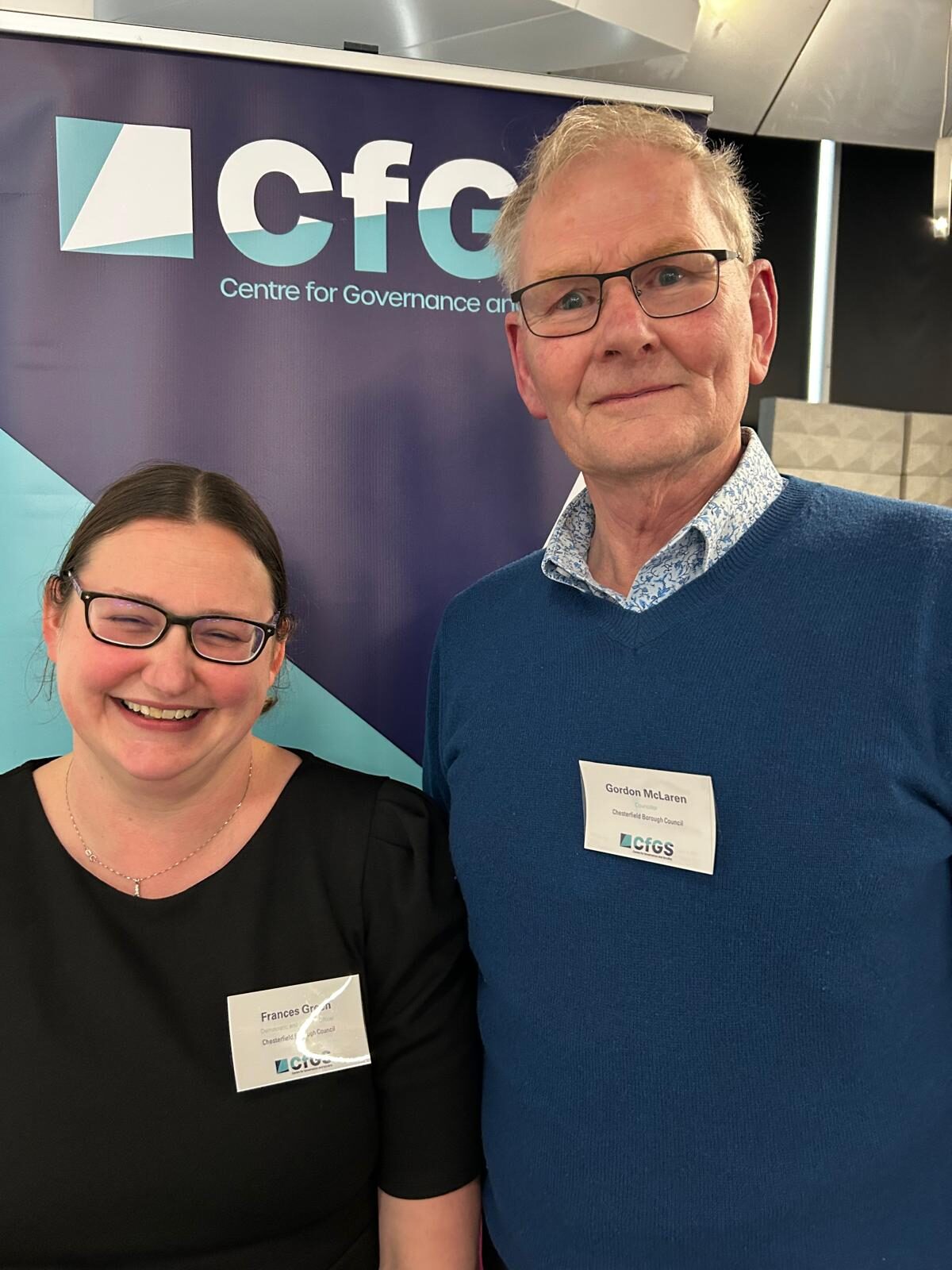
When we first met Frances and Gordon at the CfGS conference, what struck us wasn’t just their enthusiasm for scrutiny, but how they approached it together. Coming as an officer and a councillor, they brought a shared perspective that you don’t often see in the same room.
Frances had been before and encouraged Gordon to come along, knowing the experience lands differently depending on your role. Gordon arrived slightly unsure of what to expect, aware that many others there had been working in scrutiny for years.
It didn’t take long for them to find their footing. In discussions, they were often reaching similar conclusions from different starting points. Where much of the conversation leaned towards officer experience, Gordon was able to bring it back to the realities of being an elected member – what works, what doesn’t, and what it actually feels like on the ground.
Those conversations didn’t stop when the sessions ended. They carried on through the day and into a delayed journey home – comparing notes, testing ideas, and making sense of what they’d heard.
What came through wasn’t just shared learning, but a way of working. A sense that scrutiny is stronger when those different perspectives meet on equal terms, rather than sitting alongside each other at a distance.
Context
By Frances Green – Democratic and Scrutiny Officer and
Gordon McLaren – Councillor (and Vice Chair of the Licensing Committee)
Frances
We’re a borough council with a strong sense of place, and that really comes through in how both officers and members approach their roles. There’s a pride in Chesterfield that underpins everything. It’s not just about structures or governance, it’s about wanting to make the borough a better place to live and work.
Gordon
Yes, absolutely. People care about Chesterfield. It’s not just the crooked spire, it’s the wider sense that this is somewhere worth investing your time and energy. Most councillors come into it because they want to represent their communities properly, and that shared motivation helps shape the culture we’ve got.
I’m not from a traditional background for a councillor. I was a council tenant who got involved in community assemblies, just going along and listening to what was being said. That led to joining tenant groups and then getting more involved with the council through that route. I didn’t come in with any sort of managerial experience or anything like that. I always say I’m just a bog-standard bloke off the street who was interested in what was going on locally. At one of the community meetings, the leader of the council at the time asked if I’d ever thought about becoming a councillor. My first reaction was, I’m not clever enough.
So for me, it’s very much about representing the people where I live, understanding the issues because I live there too, and bringing that into the council.
Frances
Gordon is actually the councillor for the ward that I live in, and for me as a resident of the borough, I think it’s fantastic that my councillor does actually live in the ward as well. In so many places that doesn’t happen, but it means he knows the area, he understands the issues, and what’s going on locally.
From a scrutiny perspective, he’s also someone who genuinely engages. He’s always prepared for meetings, he’s read the papers, and he comes with questions and notes. That makes a real difference because it means discussions are meaningful rather than just going through the motions. He’s also very responsive. Often when I share resources or information, he’ll come back with his thoughts or reflections, which helps build that ongoing conversation outside of meetings. That’s been a big part of developing a strong working relationship.
Where we’re at
Frances
At the moment, we’re operating in a period of uncertainty because of local government reorganisation. Proposals have been submitted and we’re waiting to hear what the future structure will look like, so we’re preparing but we can’t go too far ahead just yet.
Because of that, the council plan has been extended to 2028, and we’ve aligned scrutiny with that by developing a two-year work programme. We held a development session where all portfolio holders presented their priorities for the next two years, and scrutiny members identified what they wanted to look at. That produced quite a substantial long list, really everything members were interested in.
We’re now in the process of refining that into something deliverable, working with senior officers to make sure it aligns with corporate priorities as well.
Gordon
From my point of view, that long list really does show how much there is to look at. You could spend all your time on one issue and go very deep, or you could try and cover everything and not really get into anything properly. So the challenge is deciding where scrutiny can add the most value, where you’ll get the best outcome for residents.
Current scrutiny working culture
Frances
The culture is very open and honest. Members feel able to ask for anything, and officers respond positively. It’s never really a case of saying no, more a case of how we can make this work or when is the best time to bring this forward.
Cross party working is also a real strength. Even though scrutiny should be apolitical, you don’t always see that in practice everywhere, but here, members genuinely work well together. That applies across committees, but it’s especially strong in scrutiny.
There’s also a real appetite for information. We recently had three housing reports brought purely for scrutiny, not because they were required elsewhere, and the depth and quality of those reports were fantastic. That kind of work really shows what scrutiny can achieve.
Gordon
I’d echo that. When we’re in a scrutiny meeting, it genuinely feels cross party. We’re not trying to score points or catch each other out, we’re trying to get something positive out of the discussion. If that changed, if it became political point scoring, you’d lose the value of scrutiny straight away.
Relationships between officers and members
What’s working well
Frances
For me, the relationships were already strong before we formalised anything. We developed an executive scrutiny protocol recently, but that mainly captured what was already happening rather than introducing something new.
One improvement from that is around clarity and timescales, particularly when members request further information, but fundamentally the trust and openness were already there.
Scrutiny also allows for a different kind of relationship compared to other committees. In licensing or audit, the role is more formal. In scrutiny, there’s much more opportunity for dialogue.
I often find myself doing preparatory work for members, researching topics they’re interested in, bringing back initial findings, and helping shape what a full piece of scrutiny might look like. That kind of back and forth builds a much closer working relationship.
Gordon
From a councillor’s perspective, it’s that feeling that you can ask. I don’t feel like I’m imposing if I go to Frances and say, can you help me understand this. That’s really important, especially when you’re still building your confidence. Also, when you get feedback, when an officer or cabinet member says that was a useful point you made, that builds your confidence massively. You start to feel that you’re contributing properly.
The relationship works because it’s based on understanding. Officers understand what we’re trying to achieve, and we rely on them to guide us to the areas where scrutiny can make a difference.
What could improve
Frances
I’d like to see more engagement from our local communities. If residents can see that issues that are important to them are being addressed by scrutiny committees, with probing questions being asked, and senior officers being held to account, I think it would improve trust and confidence in local democracy.
Gordon
I think for members, particularly newer ones, it’s about understanding where to focus. There’s so much information and so many potential topics, you need help to identify what really matters. Otherwise, you can spread yourself too thin or focus too narrowly.
What needs to happen
Frances
We need to keep building on what’s already there, maintaining that openness and continuing to develop mutual understanding between officers and members. The more we understand what members are trying to achieve, the better we can support them.
Gordon
And we need to hold on to that culture. Keep it constructive, keep it focused on outcomes, and don’t let it drift into something more adversarial.
Tips for others thinking about being a councillor entering scrutiny
Gordon
My background isn’t in management or politics. I came through being a tenant, getting involved in community assemblies, and gradually becoming more engaged. So when I became a councillor, I was very much learning as I went.
At first, I was quite quiet in meetings because I didn’t fully understand everything. But over time, as you build that understanding, your confidence grows and you start to contribute more.
- Ask questions, even if you think they might sound daft. Sometimes those questions are exactly what’s needed.
- Prepare for meetings. Have one or two questions you really want answered. Don’t try to cover everything, focus on what matters most to you.
- Be persistent, but do it properly, go through the chair, follow the process, and keep things constructive.
- Stay organised. I keep a diary where I log meetings, casework, and other activity. It becomes a bit of a journal. You can look back and see what you’ve actually achieved, which is really helpful.
My main advice would be to get stuck in, even if you feel out of your depth. If you’re feeling lost, go back to why you wanted to do it in the first place, to represent your community. And finally, just stick at it. Confidence doesn’t come overnight.
Tips for officers supporting councillors entering scrutiny
Frances
From my perspective, members like Gordon, who prepare, engage, and follow things through, make scrutiny much more effective.
Also, scrutiny is where relationships really develop. It’s not just about formal meetings, it’s about those ongoing conversations, the follow ups, and the shared understanding of what’s trying to be achieved.
What’s ahead for Chesterfield
Frances
In the short term, it’s about delivering the two-year work programme and navigating the uncertainty of local government reorganisation.
Looking further ahead, I’d really like to see more public engagement in scrutiny. At the moment, we have very limited attendance from residents. That’s something we should be looking to change, bringing scrutiny closer to communities and involving people more directly in decision making.
Also continuing to strengthen officer member relationships. That’s what underpins everything else.
Gordon
Yes, taking scrutiny out into communities is key. Giving ordinary people more opportunity to have a say in what’s being looked at and how services are working.
There’s also the question of resilience, making sure scrutiny is focused on what matters and can continue to operate effectively through whatever changes come with reorganisation.
At the end of the day, we’re different people in different roles, but we’re trying to achieve the same thing. That’s what makes it work.
Closing reflection
Frances
What stands out for me is that the relationship between officers and members in scrutiny isn’t something that’s been forced. It’s grown naturally through openness, trust, and shared purpose. If we can maintain that and build on it as things change, then scrutiny will stay strong.
Gordon
And it’s that shared purpose, wanting to do the best for residents, that keeps it grounded.
NOTE
At CfGS, we support local government improvement by working closely with councils to highlight the great work being done. Within this support, we produce case studies to share the lessons learned from these projects, helping other authorities benefit from the insights gained. These case studies are a collaborative effort between CfGS and the councils involved, and while they provide valuable perspectives, they are not formal evaluations of the work’s impact. Instead, they aim to inspire and inform other authorities with real examples of progress that can have a wider impact across the sector.
 All case studies