


Introduction
Last Month (March, 2026) the government introduced amendments to the English Devolution and Community Empowerment Bill that will change how scrutiny operates in established mayoral combined authorities.
While these changes will apply only to those mayoral authorities that have been announced as an ‘established mayoral strategic authority’ by the government, they represent a significant reshaping of scrutiny at mayoral level. They introduce a more clearly defined framework for overview and scrutiny committees – labelled by the government as “local scrutiny committees”– with a strengthened role within the system.
The government’s stated aim is to ensure that scrutiny can keep pace with the growing scale of mayoral responsibilities, providing greater capacity to challenge decisions, support improvement, and strengthen accountability.
At their core, the changes are about helping scrutiny to meet a more ambitious system of local governance.
Why these changes are happening
These amendments are part of a wider set of reforms in the English Devolution and Community Empowerment Bill, which the government is using to expand both the scope and scale of mayoral responsibilities.
Under the bill, mayors are expected to take on a broader range of functions – often including transport, housing, skills, economic development, and public service reform. They will receive integrated settlements that bring together multiple funding streams into a single, flexible pot under mayoral control. The government will also get the power to grant mayors more power in the future. It is also – outside the legislation itself – renaming combined and combined county authorities as ‘strategic authorities”.
As part of efforts to ensure strategic authorities develop effective governance, the bill also establishes three ‘devolution’ layers. These set out the competencies and power for county and combined authorities:
- An initial, ‘foundation’ layer for new or recently set up strategic authorities that are yet to elect a mayor
- Mayoral strategic authorities that have elected a mayor – and will be granted more powers and competencies
- Established mayoral strategic authorities – which will have the greatest competence and power. These are defined in guidance to the bill as those that “are able to satisfy additional governance requirements” and will have access to the “broadest range of devolved powers and functions, including the ability to request further devolved powers from the government.”
For now, the changes to scrutiny will only apply to the final layer – the established mayoral strategic authorities. While their number is promised to grow, at the moments these will be Greater Manchester, West Midlands, Liverpool City Region, West Yorkshire, South Yorkshire and the North East.
Evidence submitted to the Bill Committee scrutinising the proposed legislation – including from CfGS – highlighted a potential gap between the growing scale of mayoral powers and the ability of the current scrutiny system to provide effective oversight.
In that context, these amendments can be understood as an attempt to respond to at least some of that challenge: strengthening scrutiny so that it is better equipped to operate within a more powerful, complex, and interconnected system of local governance.
The reforms include:
- stronger scrutiny powers, including powers to require attendance and information from key individuals, and
- penalties – a new power for government to introduce civil penalties through regulations for non-compliance. Repeated failure by mayors, deputy mayors and commissioners to attend compulsory scrutiny meetings can also lead to loss of office
- a new right for the public to raise issues through petitions, with committees required to consider petitions that reach the statutory threshold
- a requirement for scrutiny to assess outcomes, effectiveness and value for money in the use of public resources
A significant amount of detail is still to come, with many of the practical arrangements to be set out in future government regulations.
Breaking down what the amendments mean
The amendments are detailed and, at points, technical. Taken together, they establish a more structured framework for how scrutiny is expected to operate in mayoral combined authorities.
Rather than replacing existing arrangements entirely, they clarify what scrutiny is for, strengthen some of its powers, and begin to establish a more consistent national approach.
A more clearly defined role
The legislation sets out that scrutiny committees should:
- investigate matters of local interest
- review decisions and other actions taken in connection with mayoral and combined authority functions
- make reports and recommendations
“Matters of local interest” are defined in relation to the area and to the functions and competences of the combined authority, meaning that scrutiny is now more explicitly tied to mayoral responsibilities in law.
A requirement to look at outcomes and value for money
The amendments require scrutiny to go beyond reviewing decisions and to consider:
- the outcomes those decisions are intended to achieve
- how effective actions have been in delivering those outcomes
- whether public money has been used well
Where functions involve expenditure, scrutiny reports must include an assessment of value for money.
Stronger powers to require participation
Scrutiny committees are given powers to require certain individuals to:
- attend meetings and answer questions
- provide information and documents
These powers apply to a defined group of “key persons”, including the mayor, deputy mayor, mayoral commissioners, members with relevant responsibilities, and officers. Key persons can be extended through regulations. Baroness Taylor, in setting out the amendments in the Lords, said the government will “extend to key stakeholders outside the mayoral strategic authority”. This is likely to include mayoral development corporations.
Financial penalties for non-compliance
The amendments enable the secretary of state to introduce, through regulations, a system of civil penalties for individuals who fail to comply with scrutiny requirements – for example by failing to attend, refusing to provide information, or providing misleading information. The detail of how this system will operate will be set out in regulations later.
Consequences for repeated non-attendance
The amendments also provide that mayors, deputy mayors and mayoral commissioners can lose office if they fail to attend a specified number of required scrutiny meetings within a defined period. This links continuing in these roles directly to engagement with scrutiny.
A requirement to respond to scrutiny
Where scrutiny committees make recommendations, the mayor or combined authority must:
- provide a response
- give reasons where they choose not to act
This introduces a clearer statutory expectation of accountability and transparency.
A new route for public petitions
The amendments require the establishment of petition arrangements, enabling local people to ask scrutiny committees to consider matters of local interest. Where a petition reaches a defined threshold of support, the committee must formally consider how to respond.
Resourcing
Arrangements for members’ allowances have been made already and the Bill will incorporate those into the current framework. But CAs will now need to appoint two scrutiny officers. This is not the same as the designation of a statutory scrutiny officer, as currently required, but about the officers who will be providing day-to-day support to the overview and scrutiny function.
There is also an expectation that CAs will need to involve “independent experts” in their activities – and potentially to remunerate them. This could increase the capacity and capability of scrutiny committees – if managed properly. Regulations will provide more detail.
A more structured system, with detail still to come
The amendments give government broad powers to set out further detail through regulations, including:
- committee membership and leadership
- scrutiny officers and resourcing
- the involvement of independent experts
- processes for call-in, petitions, and referrals
- the operation of financial penalties
This means that while the overall framework is now set out in legislation, much of how it will work in practice will be determined through secondary legislation.
What’s changing?
At a high level, these reforms bring a shift in emphasis. The new framework ties scrutiny more explicitly to mayoral and combined authority functions and places a stronger focus on what those powers are intended to achieve and whether they are delivering in practice.
Alongside this, several changes stand out
A clearer remit
Scrutiny is more explicitly connected to mayoral responsibilities, with a clearer sense of its role in reviewing decisions, actions and outcomes.
A stronger focus on outcomes and value for money
- There is now a statutory requirement to assess whether policies are effective and whether resources are being used well.
- Stronger expectations around participation.
Committees have clearer powers
- They will require attendance and information, supported by the potential for civil penalties introduced through regulations. This represents more formal accountability.
- The requirement for formal responses to recommendations strengthens the visibility of the relationship between scrutiny and decision-makers.
A more open route to the public
Petition arrangements provide a structured way for local people to raise issues for scrutiny.
A more developed scrutiny infrastructure
Requirements around scrutiny officers and independent experts point towards a more supported and structured model of scrutiny.
Taken together, these changes move scrutiny towards a more formalised, visible and potentially more influential role within mayoral governance.
What this means for councillors and officers
For those working in and around scrutiny, these reforms are less about starting from scratch and more about adapting to a system that is becoming more defined, more structured, and more demanding.
A more clearly defined role
Councillors involved in scrutiny will need to orient their work more directly around mayoral responsibilities – understanding where powers sit, how they are used, and what outcomes they are intended to achieve.
This may mean:
- more deliberate prioritisation and forward planning
- greater clarity about what falls within scope
- framing recommendations in ways that speak directly to decision-makers
For officers, this brings a corresponding role in supporting members to navigate a more structured and legally defined framework.
An explicit shift towards outcomes
The emphasis on outcomes and value for money changes the nature of scrutiny work. Explicitly, this increases the focus for scrutiny on:
- what difference a decision has made
- whether it achieved its intended outcomes
- whether it represented value for money
This establishes more clearly the need for deeper, more evaluative work – but it also requires stronger evidence, data and analytical capacity.
Stronger powers
With a new framework for civil penalties there will be a clear onus on:
- setting clear expectations
- ensuring relationships remain constructive
- making sure formal powers are used proportionately
There will be an ongoing need to balance between robust challenge and maintaining effective working relationships.
Greater visibility and public engagement
Petition arrangements create a more direct link between scrutiny and the public.
This may:
- increase visibility
- bring new issues forward
- require careful prioritisation and expectation management
It also presents an opportunity to strengthen the connection between scrutiny and local communities. And increase the need for a line of communication between scrutiny and media.
New expectations around capacity and capability
The expectation that scrutiny will be supported by dedicated officers and informed by independent expertise reflects a recognition that effective scrutiny requires proper resourcing.
Handled well, this could significantly strengthen the quality and impact of scrutiny. But it also raises practical questions about capacity, skills and support that are yet to be answered – and will need to be addressed by the sector working with government.
A system that will continue to evolve
Much of the detail of these reforms will be set out in regulations, and their impact will depend on how they are implemented in practice. This is not a finished model – but an evolving one.
What this means for the future of mayoral scrutiny
These reforms arrive at a point when scrutiny in mayoral combined authorities is still developing, and when many of those involved are continuing to define what effective scrutiny looks like in practice.
For many councillors and officers, the direction of travel will feel familiar. There has long been a recognition that scrutiny needs clearer expectations, stronger tools, and a closer relationship to mayoral decision-making.
But there is also a sense that legislation alone cannot fully capture what it takes to make scrutiny work well in this context.
The reality of doing scrutiny
Scrutiny at combined authority level is already complex. It often involves:
- working across organisational boundaries
- navigating relationships with directly elected mayors
- understanding large and fast-moving policy areas
- operating within limited time and resources
For many, the challenge is not just about powers – but about capacity, confidence and clarity. As we have said already, this will need careful thought and work with government to ensure councillors are sufficiently supported.
Growing expectations – and growing pressure
At CfGS we have heard concern among some practitioners that these reforms may significantly increase expectations without fully addressing the realities of delivery.
The burden on scrutiny will grow through:
- expanding mayoral powers
- increasing policy complexity
- new duties around outcomes and value for money
- additional procedural requirements
Given councillors are juggling competing demands and a significant workload already, this raises questions about sustainability, particularly if additional capacity and support do not keep pace with the increases in mayoral competence.
The importance of lived experience
A consistent message from those already doing this work is that how scrutiny operates in practice matters as much as how it is designed in legislation. Relationships, culture, and informal ways of working remain central. There is a sense that, while well intentioned, the reforms may not yet fully reflect the day-to-day realities of scrutiny in combined authorities. This points to the importance of continued engagement with practitioners as the new framework is developed.
An unfinished model – with important questions still to resolve
While the amendments set out a clearer framework for scrutiny, they do not provide a complete picture of how the system will operate in practice.
Many of the most important details – including how powers will be used, how committees will be supported, and how different parts of the system will work together – will be determined through regulations and local implementation.
This has been reflected in the parliamentary debate. For example, David Bichard (Lord Bichard) argued for the importance of more place-based approaches to accountability – such as local public accounts committees – which can take a wider view of public service performance across a geographic area.
In response, the government, through Baroness Taylor of Stevenage, raised concerns that introducing additional structures of this kind could risk overlap or conflict with existing scrutiny arrangements, potentially creating confusion about roles and responsibilities.
This exchange highlights a broader question at the heart of the reforms: how to balance clarity and consistency in formal scrutiny structures with the need to reflect how governance actually works across places.
Evidence submitted by the Centre for Governance and Scrutiny emphasised that effective scrutiny depends not only on formal powers, but on how governance operates across systems – across councils, combined authorities, public services and partners.
This raises important questions about:
- how scrutiny will operate across organisational boundaries
- how it will engage with partnership working and shared delivery
- and how it will reflect the realities of place, rather than operating solely through formal institutional structures
These are not questions that legislation alone cannot resolve – but they will be central to whether the new system works as intended in practice.
Looking ahead
The future of mayoral scrutiny will not be determined by legislation alone, but by how these still-evolving arrangements are interpreted, implemented, and adapted in practice. It will depend on:
- how committees use their powers
- how relationships develop between scrutiny and executive leadership
- how the system learns and adapts over time
For councillors and officers already doing this work, this is not just a moment of change – but a chance to help define what effective scrutiny looks like in a maturing system of local governance.
Appendix: Description of the changes in detail
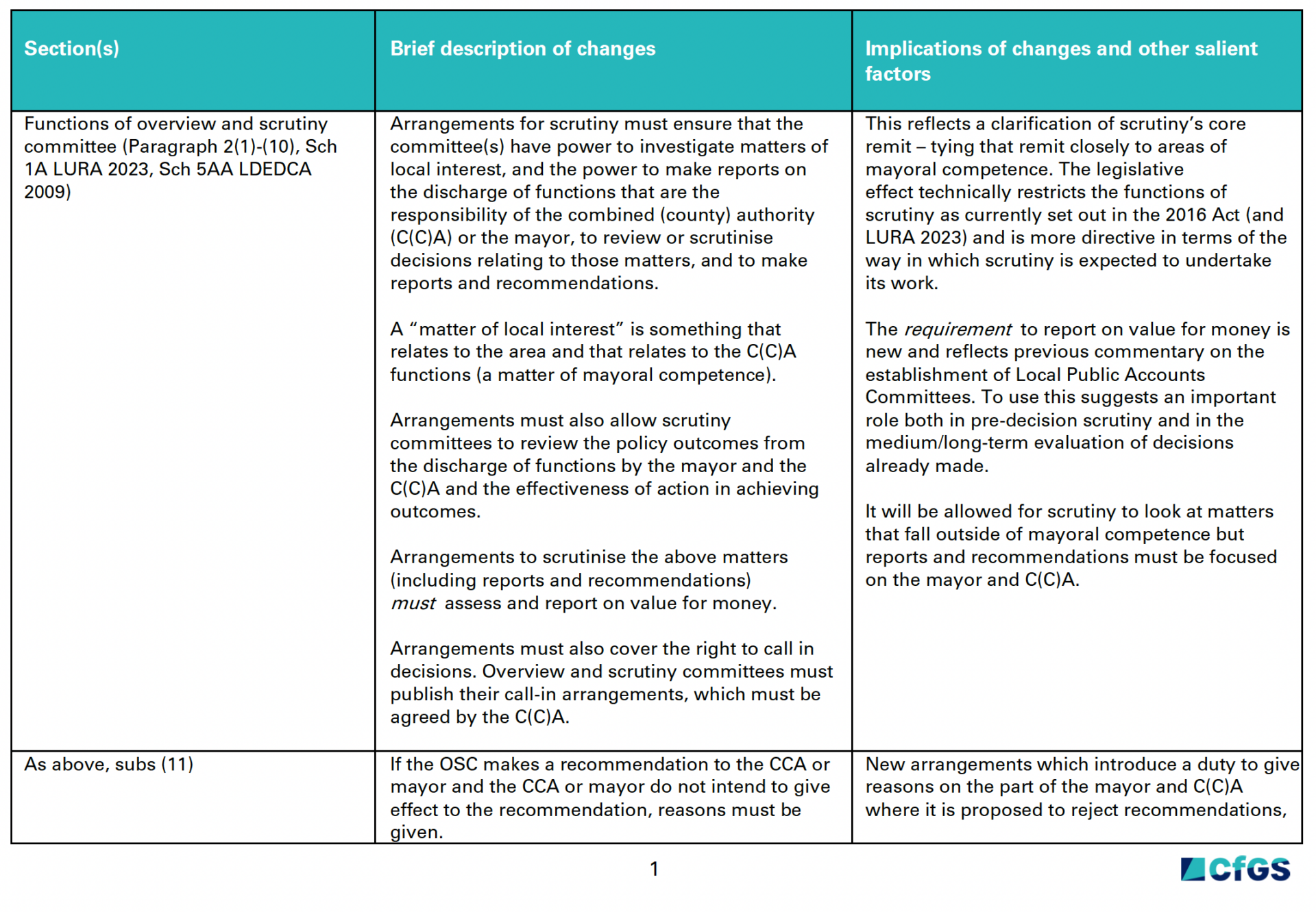
This table provides detailed information on each change the amendments will make to the English Devolution and Community Empowerment Act. The section numbers below apply to the new section numbers of the legislation being amended, as set out on the amendment paper.
There is a regulation-making power under paragraph 4 and a broad guidance-making power under paragraph 3(15).
Under these new arrangements overview and scrutiny committees will in due course be known as “local scrutiny committees”, or may have another name designated by regulations.
Government amendments also bring about changes to the operations of audit committees. Although these changes are minor, the introduction to overview and scrutiny committees of duties around value for money does suggest the need for conversations about the intersection between the roles performed by scrutiny councillors and their audit counterparts.
Note: Because combined and combined county authorities were set up in different legislation, the amended bill has separate schedules to create the new scrutiny arrangements. However, the paragraphs we note apply for both schedules.
 All resources