


Introduction
Joint scrutiny matters when an issue, service, provider or governance arrangement cannot sensibly be understood through the lens of one authority alone.
That is increasingly common. Councils work across shared services, partnerships, strategic boards, combined authority arrangements and wider systems. Large providers may operate across several places. Some issues – from transport to health to major contracts – cut across administrative boundaries. In those circumstances, separate scrutiny may leave gaps, duplicate effort, or fail to reflect where accountability and influence sit.
About this guide
This guide is for scrutiny councillors and officers who are considering, setting up or supporting joint scrutiny. It focuses on practice:
- when joint scrutiny is worth considering
- what different models look like
- how to choose the right approach
- what needs to be in place before formal arrangements begin
- what makes joint scrutiny work well in practice
This is not a legal handbook. Authorities should always consider the relevant statutory framework, constitutional arrangements and legal advice. But the purpose here is practical: to help people design joint scrutiny that is purposeful, workable and useful.
1. What is joint scrutiny?
Joint scrutiny is where two or more scrutiny bodies work together to examine an issue, service, provider, partnership or decision-making arrangement because doing so together will be more effective than acting separately.
It may be:
- formal or informal
- time-limited or ongoing
- focused on one issue or part of a wider arrangement
- light-touch or more resource-intensive
There is no single model. Joint scrutiny is best understood as a range of approaches.
What it is for
At its best, joint scrutiny helps authorities to:
- see the whole picture on shared issues
- reduce duplication
- strengthen democratic oversight across boundaries
- examine where accountability really sits
- bring different local perspectives together around a shared concern
What it is not
Joint scrutiny is not:
- just a bigger meeting
- automatically the right answer for every cross-boundary issue
- a substitute for each council doing its own scrutiny well
- effective simply because a formal structure exists
A joint scrutiny committee on paper is not the same thing as good joint scrutiny in practice. Remember, the formal arrangement is only one part of the story; the real challenge is whether people have designed and supported it well enough to make it work.
Practice box: a useful starting question
Would separate scrutiny leave important gaps?
YES – If the answer is yes, joint scrutiny may be worth considering.
NO – If the answer is no, a lighter form of coordination, or a one-off activity may be enough.
2. When should you consider joint scrutiny?
Joint scrutiny is worth considering where the issue is genuinely shared and where collaborative scrutiny is likely to add value.
Typical scenarios include:
Where councils are delivering or commissioning together, and scrutiny of the issue would be weaker if carried out separately.
Where the issue affects more than one place and does not stop neatly at local authority boundaries.
Where accountability is spread across organisations, or where the issue sits in the relationships between bodies rather than within one institution. Read more about effective accountability here.
This may include major contractors, utilities, trusts or other organisations whose activity affects several authorities.
Where responsibility is split across councils, combined authorities, mayoral structures or other strategic bodies.
For example, during local government reorganisation or other periods of transition. This is covered later in the guide.
A simple test
Before proceeding, ask:
- Is the issue genuinely shared?
- Will scrutiny be stronger if we work together?
- Will separate scrutiny create duplication or leave gaps?
- Is there a clear shared purpose?
- Do we have enough capacity and commitment to do this well?
- Does this need a formal arrangement, or would lighter coordination be enough?
A helpful test from the practitioner discussion is whether there is enough capability, competence and commitment to make the work effective. Joint scrutiny often fails not because the idea is wrong, but because one or more of those ingredients is missing.
When the answer may be “not yet”
Sometimes joint scrutiny makes sense in principle, but the conditions are not there yet. That may be because:
- officer capacity is too stretched
- relationships are not developed enough
- the purpose is still unclear
- the evidence base is too weak
- the issue has not been scoped tightly enough
In those cases, it may be better to begin with:
- informal co-ordination
- aligned work programming
- a shared briefing
- a joint workshop
- a short scoping exercise
3. Choosing the right model
The right model depends on the issue, the purpose, the relationships involved and the capacity available.
A good rule of thumb is: choose the lightest arrangement that can still do the job properly.
Informal co-ordination
This might include shared intelligence, aligned work programmes, joint briefings or co-ordinated questioning by separate scrutiny bodies.
This may work best where:
- the issue is emerging
- the scope is still being tested
- trust is still developing
- capacity is limited
Formal joint scrutiny committee
A formal committee structure with agreed membership, governance and reporting arrangements.
This may work best where:
- the issue needs sustained oversight
- accountability is shared over time
- there is value in formality and visibility
- continuity matters
Joint task and finish work
A time-limited arrangement focused on a specific review or question.
This may work best where:
- the issue is clear and bounded
- the work has a defined end point
- authorities want joint work without creating a standing body
Choosing proportionately
Do not start with the structure. Start with the problem.
Ask:
- what exactly needs scrutiny?
- how formal does the arrangement need to be?
- what level of co-ordination is proportionate?
- what can realistically be supported well?
More formal arrangements are not always better. Sometimes they create unnecessary delay or burden. Sometimes they are exactly what is needed. The important thing is to make the choice deliberately and with careful consideration of the trade-offs.
Joint scrutiny when governance is shared
Where services or governance are already deeply shared, scrutiny may need to be brought together to reflect that reality – for example in the case of councils that share a management structure and a chief executive. This would involve a formal joint committee but might require additional design considerations, given that these councils will share a range of services, committees and governance arrangements.
Practice box: signs you may be over-designing
You may be choosing too formal a model if:
- the purpose is still vague
- nobody has scoped the issue properly
- officer support is unclear
- members have not yet built any shared understanding
- a lighter arrangement could test the ground first
4. Setting up joint scrutiny
This is where practice really starts to matter – joint scrutiny is often won or lost before the first formal meeting.
Start with alignment
Before formalising anything, invest time in:
- early conversations between chairs
- officer-level discussion
- shared scoping of the issue
- surfacing different assumptions and priorities
- understanding how scrutiny operates in each authority, including different organisational cultures and ways of working
- exploring how participating bodies approach scrutiny recommendations, including how they respond, track and follow up actions
- building some initial trust
This is not background admin. It is part of the scrutiny design.
Differences in scrutiny culture and practice are normal, but if they are not understood early, they can create friction later – particularly when agreeing recommendations or expecting a consistent response across organisations.
Agree purpose and scope
Be clear about:
- what is being scrutinised
- why joint scrutiny is needed
- what questions the work is trying to answer
- what success would look like
- what sits outside scope
A vague mandate will almost always create problems later.
Think about Key Lines of Enquiry (KLoE) to get started – see some examples below.
Decide who really needs to be involved
Not every organisation with some interest in the issue needs to be a full participant.
Be realistic about:
- which authorities are core to the arrangement
- who needs to be involved directly
- who should contribute evidence rather than sit as a member
- whether the group needs to be broad or tightly focused
Put governance in place
This includes:
- terms of reference
- membership and representation
- chairing arrangements
- reporting lines
- review points
- the level of formality required
All of that matters. But governance is only part of the answer. A well-drafted structure will still struggle if people have not thought through how the group will actually work together.
Think carefully about representation
Political balance and representation are often sensitive in joint scrutiny, especially where participating authorities have different compositions or different expectations about proportionality.
Authorities will need to consider:
- how members are nominated
- how proportionality will be handled
- whether representation is equal or weighted
- how different local voices will be heard
Clarify roles early
Joint scrutiny works better when people know who is doing what.
Be explicit about:
- the role of members
- the role of the chair
- the role of scrutiny officers
- who is coordinating the work
- who is managing evidence, logistics and drafting
- who acts as the main point of contact across authorities
Consider whether a lead authority is needed
A lead authority can help with:
- coordination
- agendas and papers
- logistics
- evidence gathering
- draft reporting
This role should be consciously agreed and properly supported. It should not become an invisible burden that falls on one officer team by default. Both the practitioner discussion and the LGR material reinforce this point.
5. Designing for joint working
Joint scrutiny is not only about formal arrangements. It is about how people from different organisations, places and political contexts are enabled to work as one scrutiny body around a shared purpose.
Design for joint working, not just attendance
The aim is not simply to get representatives from different councils into the same room. The aim is to enable them to scrutinise effectively together.
That means agreeing:
- what the shared purpose is
- how members will work together
- how local interests will be handled
- how difference and disagreement will be managed
- how the group will stay focused on a common task
There may also be practical implications for each authority’s constitution and scrutiny procedures. For example, how joint work is recognised, how recommendations are reported, and how responses are handled may vary between councils. These differences do not need to be identical, but they do need to be understood and, where necessary, aligned well enough to support the joint work.
Build relationships and trust
Trust does not appear automatically because a joint arrangement has been established.
It may need to be built through:
- informal pre-meetings
- joint briefings
- member workshops
- time to develop shared understanding before formal sessions begin
This can feel like a soft extra. In practice, it is often what makes the formal scrutiny possible.
Work through differences openly
Different organisations may bring:
- different political priorities
- different local pressures
- different organisational cultures
- different levels of scrutiny confidence
- different expectations of the process
These differences are normal. The important thing is to bring them into the open early enough to work through them constructively.
Keep returning to shared purpose
Joint scrutiny can drift if members default back to representing only their own patch. That is understandable, but it can weaken the work if it becomes the dominant mode.
The chair and supporting officers have an important role in helping the group return to the shared question: what are we here to understand or influence together?
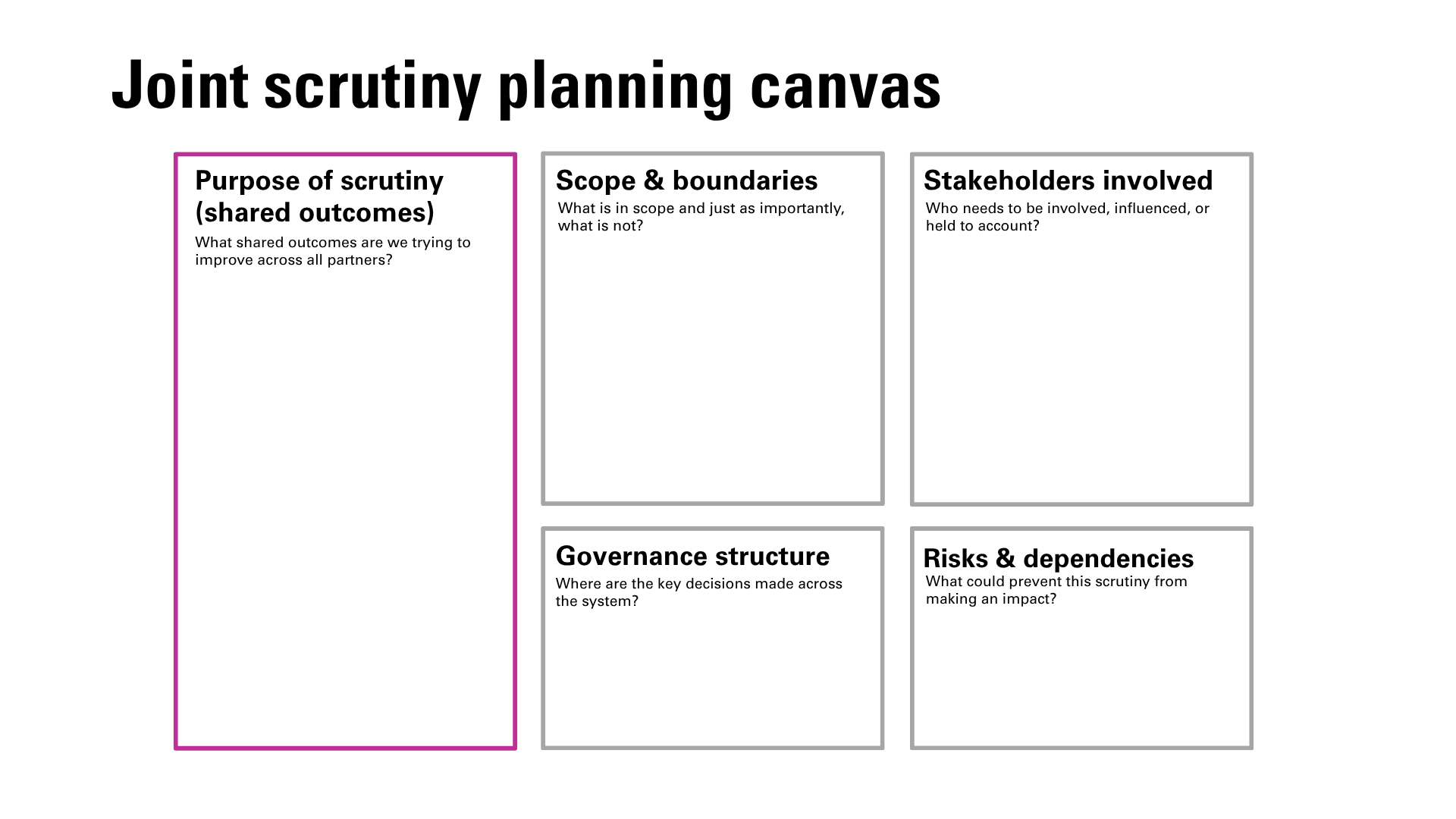
Try using the canvas below to start working together.
Practice box: a helpful chairing prompt
When discussion becomes fragmented, a useful question is:
What is the shared issue here, and what can only this joint group do?
6. Evidence, insight and communication
Joint scrutiny depends heavily on good evidence. This needs more emphasis than it often gets – evidence and data may be incomplete, inconsistent or hard to compare across authorities. That is not a side issue – it is often one of the biggest practical barriers to effective joint scrutiny.
Plan the evidence early
Think early about:
- what information the group will need
- whether data can be compared across areas
- where the evidence gaps are
- what external expertise may be needed
- how briefing papers will support shared understanding
Do not assume the data will do the job on its own
Even where data is available, it may not be enough.
Joint scrutiny often needs:
- interpretation
- context
- explanation of local differences
- clarity about what can and cannot be compared
Support members to work from a shared evidence base
Good joint scrutiny is easier when members are working from a common understanding of the issue, the terminology and the available evidence.
That may require:
- shared briefing material
- officer-led explainer sessions
- common lines of enquiry
- advance clarification of what the evidence can and cannot tell you
Plan communication and visibility
Joint scrutiny is often under-communicated.
That matters because visibility affects:
- legitimacy
- public understanding
- stakeholder engagement
- the impact of recommendations
Think about:
- how the work will be described publicly
- who is speaking for the group
- how findings will be published
- how communities across different places will hear about the work
Design for follow-through
From the start, be clear about:
- who recommendations are aimed at
- how responses will be received
- how progress will be tracked
- whether there will be a follow-up stage
Impact should not be an afterthought.
7. Resourcing joint scrutiny properly
Good joint scrutiny depends on proper support. It requires capability, competence and commitment – and those do not materialise by accident.
Why resourcing matters
Joint scrutiny often creates additional work:
- Co-ordination across authorities
- more complex scheduling
- more demanding evidence gathering
- larger briefing requirements
- relationship management
- report drafting
- communication and follow-up
- These demands are easy to underestimate.
Be honest about officer burden
A recurring practical reality is that the burden falls heavily on one or two officers, often through goodwill rather than formal resourcing, this should not simply be accepted as normal.
What support may be needed
Depending on scale, joint scrutiny may require:
- dedicated scrutiny officer time
- administrative support
- research and analysis
- coordination across organisations
- communications support
- technical or subject expertise
A practical principle
If authorities want joint scrutiny to do serious work, they need to think seriously about how it will be supported.
That may mean:
- sharing officer support
- pooling capacity
- agreeing the limits of the lead authority role
- identifying where additional specialist support is needed
8. Common pitfalls
A formal body is set up before anyone has agreed what it is for.
The work is treated as an add-on rather than a substantial piece of coordination.
Members are expected to operate as a coherent group without any groundwork.
Different pressures or assumptions are left unspoken until they cause tension later.
A heavyweight structure is created before the issue is clear or the relationships are ready.
Not enough thought is given to data quality, comparability or evidence gaps.
Recommendations are produced without clear arrangements for response and follow-up.
9. Joint scrutiny in periods of structural change
Joint scrutiny may become especially relevant during periods of structural change, including local government reorganisation, because governance, accountability and delivery arrangements are often in flux while important decisions are being taken across more than one authority area.
In these contexts, joint scrutiny may help to:
- provide accountability for a programme of change
- create space for challenge and reflection
- widen political ownership
- build cross-council relationships and trust
An important lesson is that arrangements may need to evolve. A model that is proportionate during transition may not be the right long-term arrangement once new governance structures are established.
Model choice in these circumstances is often shaped by practical trade-offs, including:
- speed and ease of implementation
- political balance
- cost
- flexibility over time
- whether formal powers are needed
- where support will sit.
In an LGR context, ask:
- what exactly needs scrutiny: programme, risk, delivery, engagement or implementation?
- is a shared body needed, or will aligned scrutiny be enough?
- how will representation work across councils?
- where will officer support sit?
- is the arrangement transitional or intended to last?
10. A practical checklist
Before starting joint scrutiny, ask:
- Is the issue genuinely shared?
- Why will scrutiny be better together than separately?
- What added value are we looking for?
- What is the lightest model that can still do the job properly?
- Do we have the capability, competence and commitment to make it work?
- Have we done enough groundwork before formalising the arrangement?
- Are governance, representation and roles clear?
- Have we planned realistically for officer support?
- Do we have a workable evidence plan?
- How will communication, recommendations and follow-through be handled?
- Does the arrangement need to evolve over time?
Final reflection
Joint scrutiny is one of the ways scrutiny can respond to the growing complexity of public governance.
It allows councils to examine issues as they are actually delivered, experienced and governed – not just as they appear within one organisation’s boundaries.
But it only works well when it is designed with care. Purpose matters. Relationships matter. Evidence matters. Officer support matters. A formal structure may help, but it will not by itself create effective joint scrutiny.
Where the conditions are right, joint scrutiny can provide stronger oversight, better shared understanding and a more credible response to cross-boundary public issues. Where those conditions are not in place, the wiser course may be to start smaller, build the foundations, and grow from there.
References
1. CfGS, 2019, Good Scrutiny Guide (4th ed.)
2. CfGS, Scrutiny of partners and external organisations
3. CfGS, Planning and priority setting for scrutiny
4. CfGS, Relationships for effective governance and scrutiny
5. CfGS, Scrutiny and local government reorganisation
6. MHCLG, 2019, Overview and Scrutiny Statutory Guidance for Councils and Combined Authorities
7. DHSC, 2014 (updated), Local authority health scrutiny: guidance to local authorities
8. LGA, 2023, A Councillors workbook on Scrutiny
9. Sharma, S., 2026, Discussion on joint scrutiny practice and design (interviewed for this guide)
 All resources