


Written with much thanks for the valuable contributions from East Midlands and London Regional Scrutiny Networks
Introduction
Scrutinising partners and external organisations is challenging work. It requires judgement, confidence and a willingness to work differently.
But when done well, this form of scrutiny:
- Reflects how services are really delivered
- Strengthens place-based accountability
- Gives residents a voice where it might otherwise be missing
By combining formal powers with soft power, thoughtful design and strong relationships, scrutiny can play a vital role in shaping better outcomes – even beyond the council.
Why this guide matters
Scrutiny was never meant to stop at the council’s front door.
In today’s public service landscape, many of the things that matter to residents – including services, strategies, policies and long-term decisions about place (for example housing, health, transport, utilities and community safety – are delivered with partners, through partnerships, or by external organisations.
Yet scrutiny arrangements have not always kept pace with this reality.
Residents do not distinguish between who is formally responsible for a service or decision. They experience outcomes as part of a single system and expect democratic accountability to reflect that. Where scrutiny focuses primarily on the council’s direct decisions, it risks missing the bigger picture and, in some cases, becoming disconnected from lived experience.
This guide is designed to help scrutiny confidently and effectively engage with partners and external organisations. It brings together legal context, practical learning, and tested approaches from across the sector to show how scrutiny can add value beyond the council, even where formal powers are limited.
Why scrutiny needs to look beyond the council
Public services, decisions and outcomes are increasingly complex, fragmented and interconnected. Commissioning, outsourcing, regulation, partnership working and commercial delivery have created distance between decision-making and delivery, often across organisational and geographical boundaries. This presents real challenges for oversight, accountability and democratic leadership.
In this context:
- The council may not directly deliver a service, but may still have a leadership, convening, stewardship, commissioning or contracting role
- Poor outcomes are rarely the result of one organisation acting alone
- Accountability can fall between the cracks if scrutiny remains narrowly focused
Scrutiny that engages with partners helps to:
- Reflect how services and decisions operate in practice
- Join up evidence from different parts of the system
- Surface gaps, tensions and unintended consequences
- Give voice to residents’ experiences where no single body “owns” the issue
In short, scrutiny of partners is not an optional extra. It is essential to understanding how decisions affect people and place. However, it is important to remember that scrutiny does not operate in isolation, and forms part of a wider accountability system.
Place based ecosystem example
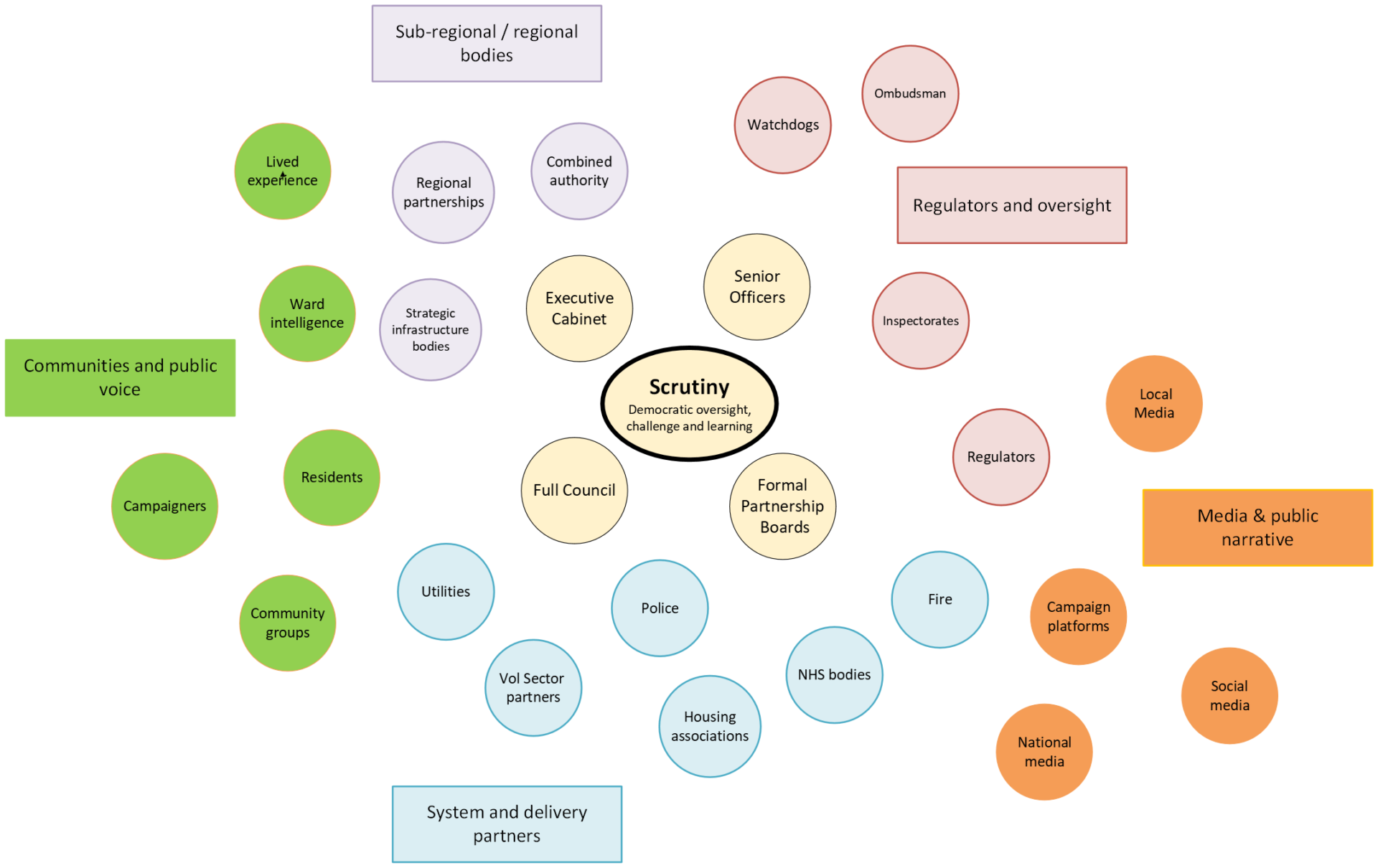
What powers does scrutiny have beyond the council?
Scrutiny committees sometimes underestimate their powers, however outward-facing scrutiny is also shaped by organisational culture and corporate confidence. In some councils, scrutiny is still seen primarily as an internal function, which can limit its engagement beyond the council even where the legal framework allows it.
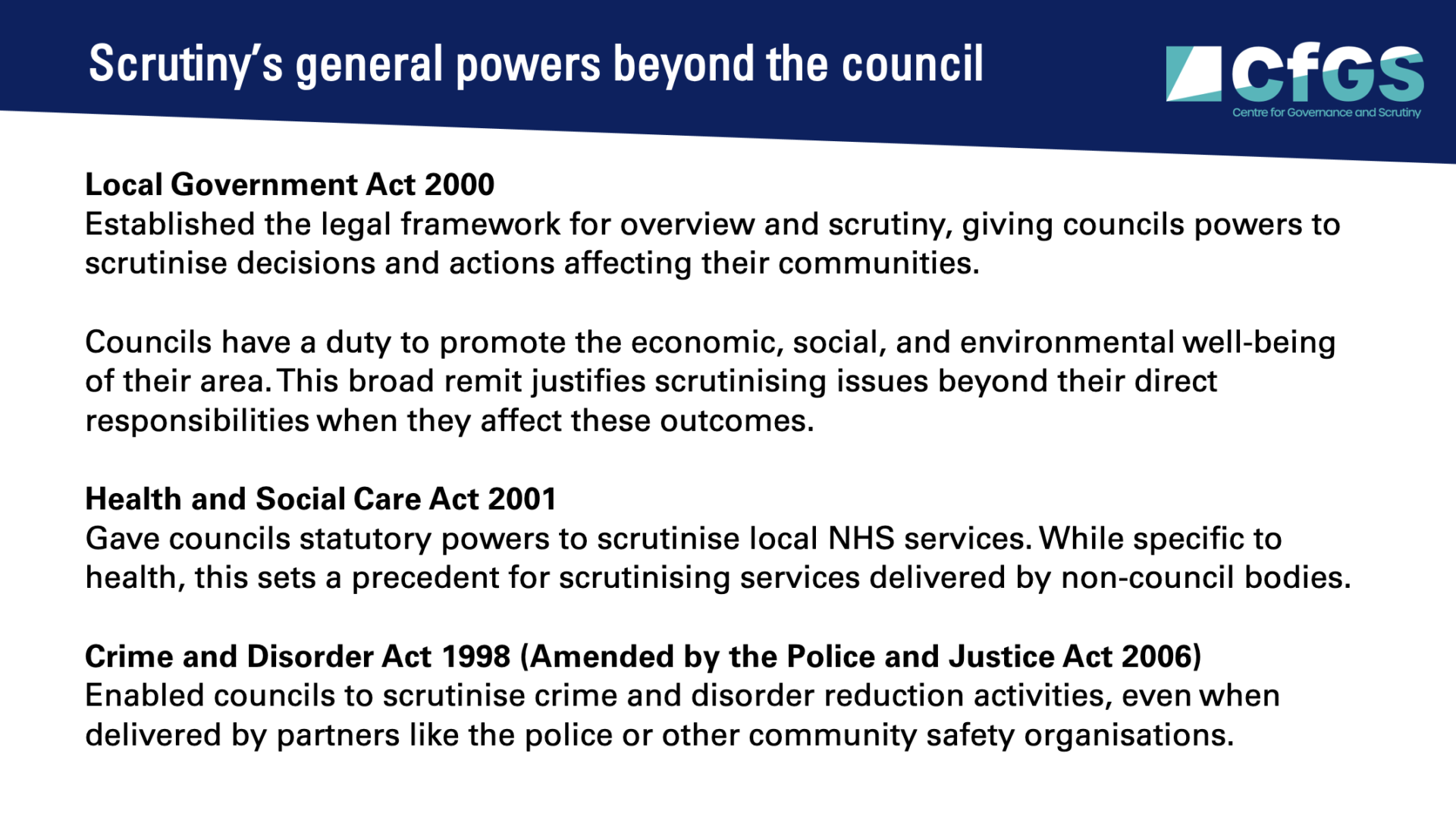
The legal framework for scrutiny provides councils with a broad basis to examine matters affecting their area or its residents, including where responsibility for decisions or delivery sits elsewhere.
Statutory foundations
Key legislation establishes that scrutiny may consider matters of local concern affecting the area or its inhabitants (see slides below). In practice, this can include decisions, actions and outcomes arising from a wide range of organisations that shape place – not only statutory partners, but also non-statutory bodies, community and voluntary organisations, and others whose activities have a material local impact.
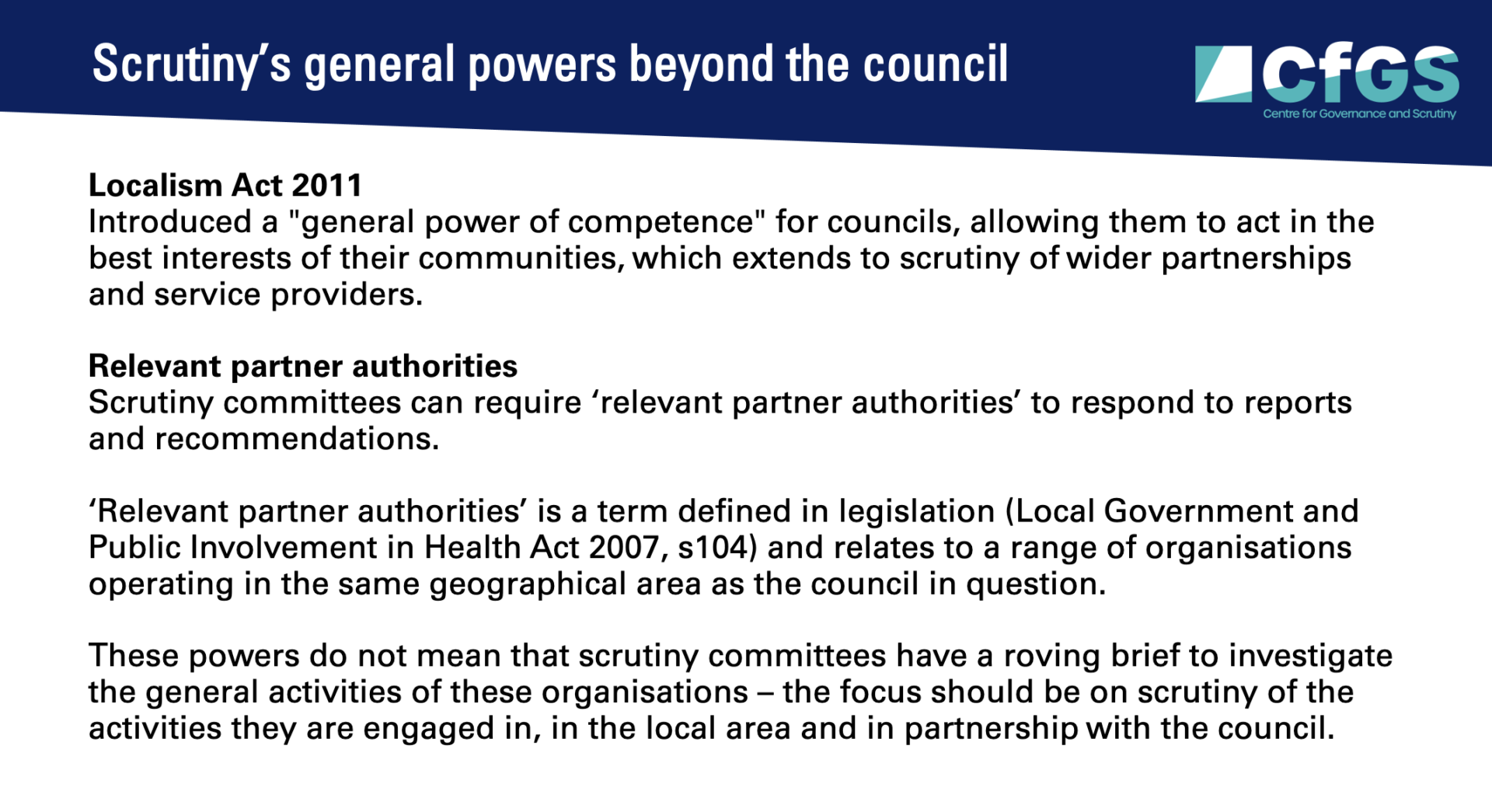
Councils now operate under a general power of competence, which supports a broad approach to scrutiny where issues affect local people and place.
Specific statutory scrutiny powers exist in certain areas, most notably in relation to health services and community safety, with more limited or time-bound powers applying in other areas (such as flood risk).
In addition, scrutiny committees may make reports and recommendations to defined “relevant partner authorities”, to which those bodies must have regard, subject to the notification process.
These powers are important. However, they are only part of the story.
Relevant partner authorities
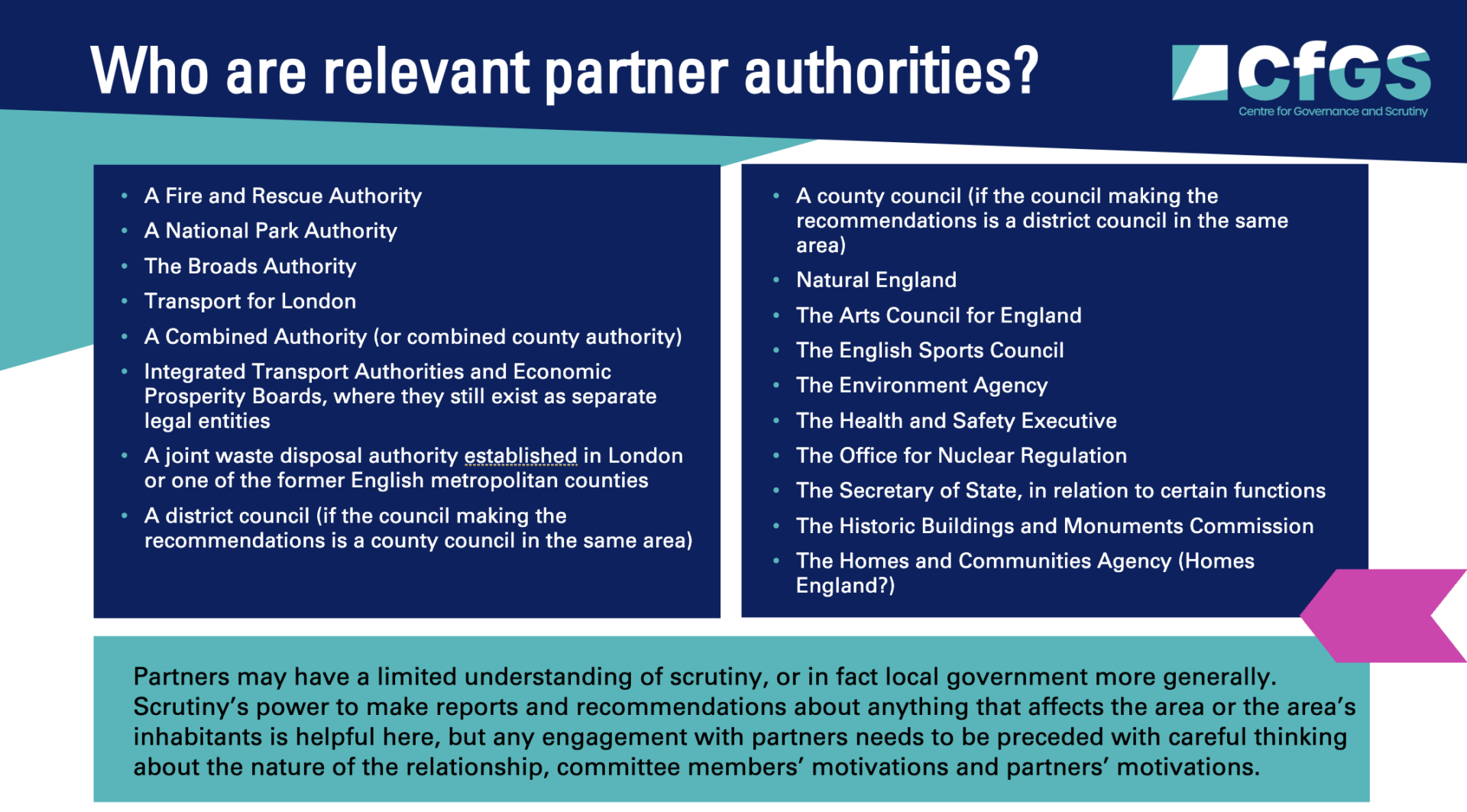
Legislation defines a list of “relevant partner authorities” that scrutiny committees can formally engage with. In practice, this includes the ability to request information, invite representatives to attend meetings, and make reports and recommendations to which those bodies must have regard, subject to the notification process.
These authorities include bodies such as fire and rescue authorities, combined authorities, regulators and certain national agencies. However, scrutiny can sometimes default to engaging with familiar or established partners — often those the council already contracts with or has existing relationships with. Effective scrutiny may require looking beyond these “usual suspects” to understand how a wider range of organisations influence outcomes for place.
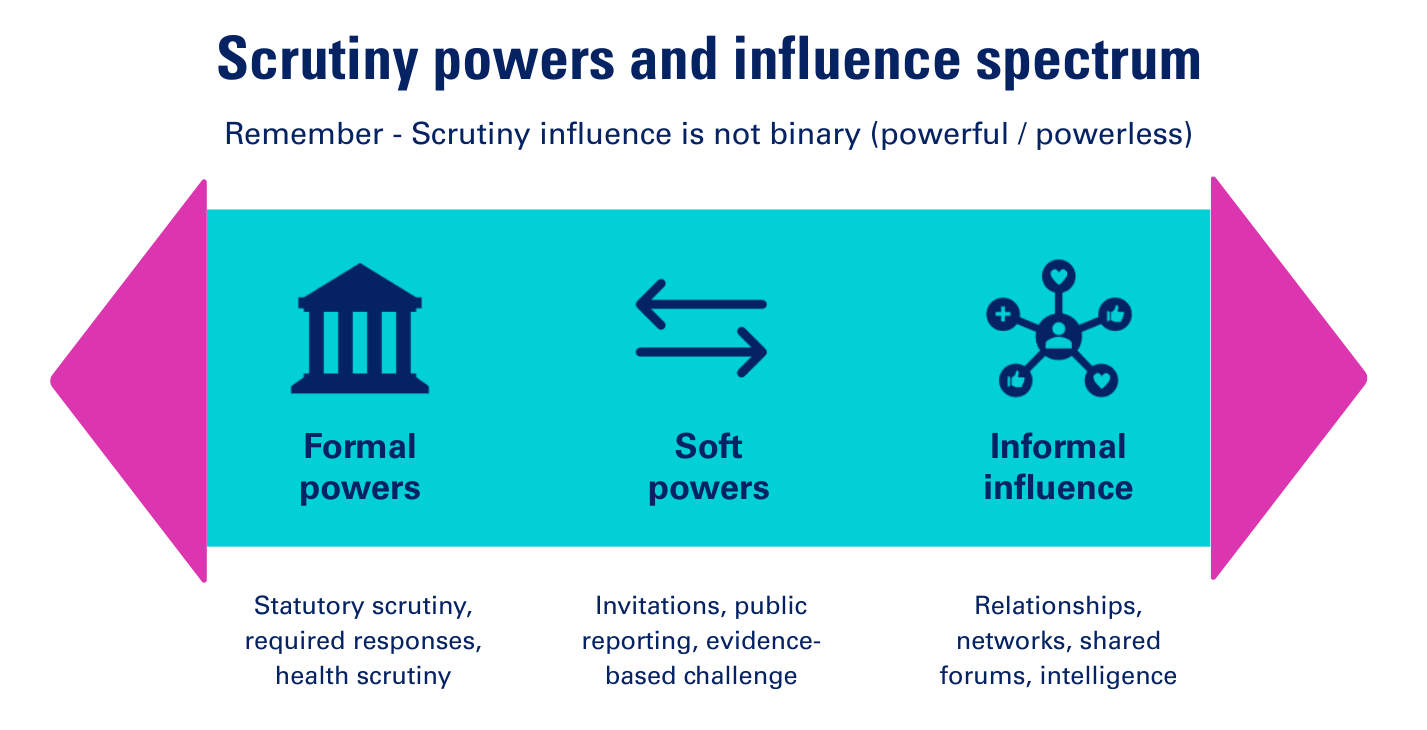
However:
- These powers relate to activities in the local area, not the general performance of the organisation
- They do not automatically guarantee meaningful engagement
- They are rarely sufficient on their own to deliver effective scrutiny
The limits of formal power
In practice, many of the organisations that shape local outcomes:
- Are not under a statutory duty to attend scrutiny
- Operate at regional or national scale
- Have their own governance, accountability and risk frameworks, separate from those of the council
In addition, partners may respond cautiously or negatively where they are unfamiliar with scrutiny as a democratic process, unclear about its powers, or where the initial approach feels overly legalistic or adversarial.
This does not make scrutiny powerless. It simply means that how scrutiny engages, including the clarity of its purpose, the tone it sets and the relationships it builds, matters as much as whether it has formal authority.
Common pitfalls to avoid
- Assuming you need a statutory power before you can act
- Over-relying on legal language when a clear explanation of purpose and expectations would be more effective.
- Using formal powers without first explaining purpose and scope
- Assuming that partners understand the role of scrutiny and how it operates
The soft power of scrutiny: influence, relationships and legitimacy
Much of scrutiny’s impact with partners comes from soft power rather than formal compulsion.
Soft power includes:
- The ability to invite and convene
- The visibility of public meetings and published reports
- The credibility that comes from evidence-based challenge
- The reputational impact of being seen to engage, or not engage
Used well, these can be highly effective.
Relationships matter
Relationships can be an important enabler of effective scrutiny of partners, particularly in complex policy areas such as health, community safety or system-wide reform. However, scrutiny committees will need to be realistic about capacity and focus their efforts where relationship-building is most likely to support their priorities.
Relationships cannot be switched on and off to suit the scrutiny work programme. Committees that are most effective at engaging partners tend to:
- Build contact outside formal meetings, informed by an understanding of partners’ motivations, priorities and constraints
- Use existing networks, forums and partnerships as routes into engagement
- Understand who holds influence as well as formal responsibility within the system
Housing forums, business groups, area partnerships and community networks may not exist “for scrutiny”, but they often provide valuable insight and access. To use them effectively, members need to understand the role these bodies play within the wider partnership ecosystem, for example whether they are decision-makers, influencers, delivery bodies or scrutineers in their own right.
At the same time, committees need to be mindful of the risks and practicalities of relationship-building, including:
- Forums or networks dominated by particular voices
- Confusing relationship-building with endorsement
- The need to maintain independence and constructive challenge
- The potential for executive-side relationships to muddy scrutiny’s role
- The resource and capacity implications of maintaining relationships, including clarity over whether this role is led by members or officers, and how continuity is managed over time
Top tips: engaging partners constructively
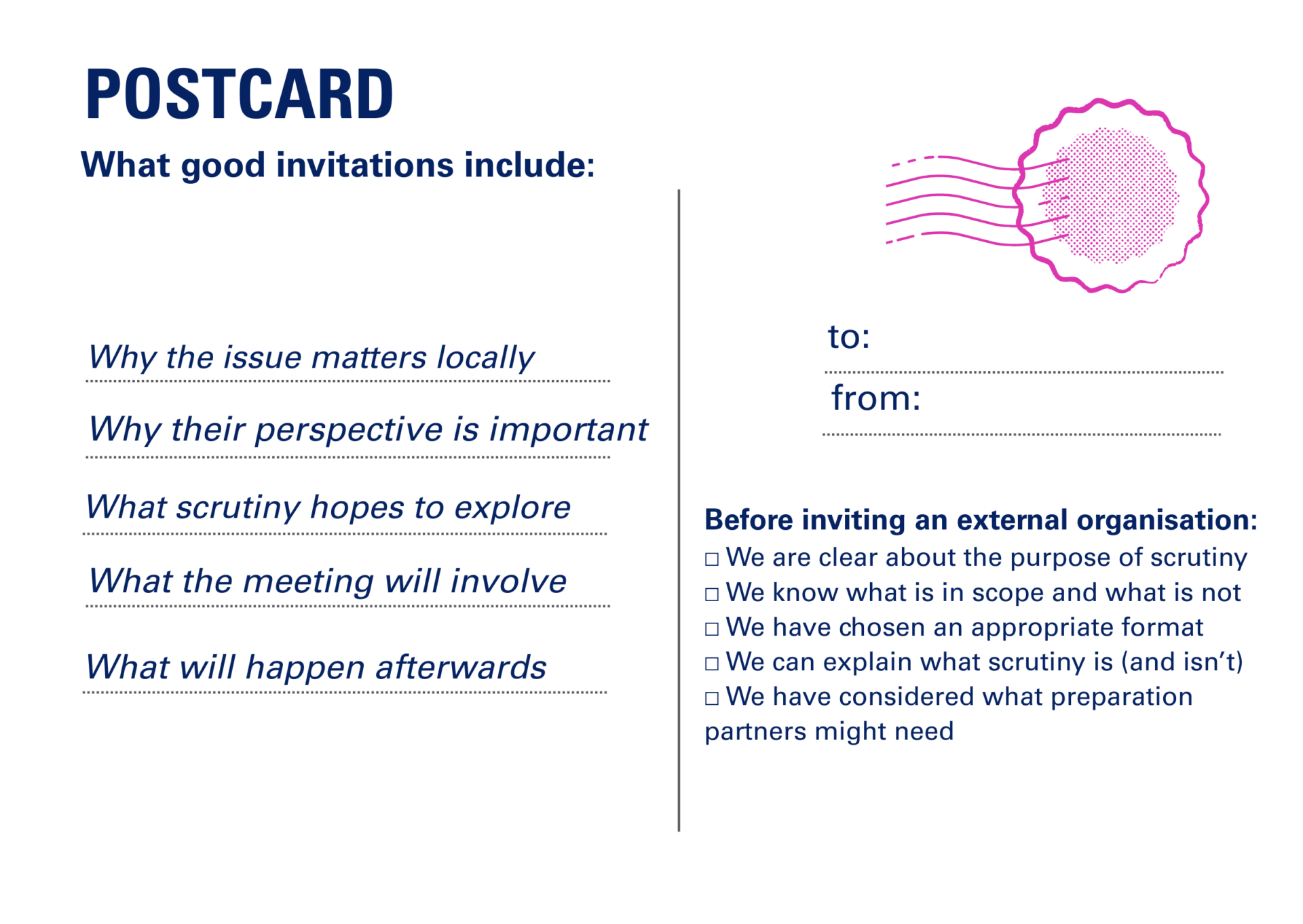
- Be explicit about why you are inviting an organisation and what scrutiny is trying to achieve, including whether engagement is intended to hold a partner to account or to support wider discussion, learning or system understanding.
- Different partners will respond differently to accountability language, and this should inform your approach.
- Where appropriate, share likely lines of inquiry in advance. This can build trust and improve the quality of evidence but may not suit every purpose or context.
- Think about what’s in it for them: learning, clarity, influence and reputation
- Treat partners as contributors to place, not just service providers
Transparency creates pressure
Public scrutiny creates a different dynamic from private engagement. Even where attendance is voluntary, organisations are often sensitive to:
- Public expectations
- Media interest
- The reputational impact of declining to engage
Clarity about purpose, scope and process helps ensure this pressure is constructive rather than adversarial.
When scrutiny becomes performative
Ask yourselves honestly:
- Are we clear what difference this scrutiny will make?
- Are we seeking understanding, accountability — or reassurance?
- Would we design this scrutiny the same way if the organisation were engaging voluntarily?
- If this scrutiny feels performative, is it more likely to undermine engagement than strengthen influence?
Common pitfalls to avoid
- Trying to scrutinise an organisation “as a whole”, rather than focusing on a specific issue, decision, outcome or risk.
- Confusing relationship-building with lack of challenge
- Designing scrutiny for the committee rather than for the issue
- Relying solely on formal powers when informal influence would work better
External organisations are more likely to engage meaningfully when scrutiny is clear, focused and proportionate.
People may be invited to participate in scrutiny for a range of reasons – to be held to account, to contribute to policy development, or to support members’ understanding of issues and challenges across related service areas. Being clear about the purpose of engagement will influence who is invited, the format used, and the tone of the discussion.
Effective scrutiny of partners is rarely a standalone activity. It works best when understanding of partners, the wider partnership landscape and key local issues is built into work programming and agenda-setting from the outset, rather than treated as a separate or exceptional form of scrutiny.
Poorly designed scrutiny – for example where it is vague, overly broad or performative – discourages engagement and undermines credibility. Well-designed scrutiny, by contrast, signals seriousness and respect for everyone’s time.
Scrutiny is sometimes perceived as something that is done to external organisations. In practice, many partners value good scrutiny when it is well designed and conducted in the right spirit.
External organisations often report that effective scrutiny:
- Provide a structured opportunity to explain decisions, context and constraints
- Offers a different perspective that may be harder to access internally
- Demonstrates openness and transparency to residents and stakeholders
- Helps shape thinking and improve practice
- Supports shared understanding across a complex system
When scrutiny is approached as part of a shared place-based system, with clarity of purpose, a respect for different roles and a focus on outcomes – it is often welcomed rather than resisted.
However, this does not mean avoiding challenge. Robust questioning remains essential. However, challenge that is focused, evidence-based and proportionate is more likely to result in constructive engagement and meaningful impact than approaches that feel adversarial or performative.
Be clear about purpose
As with all scrutiny topics, before inviting partners committees should be able to answer:
- Why this issue matters now
- What scrutiny is trying to understand or influence
- What is in scope — and what is not
This clarity helps manage expectations, shape appropriate engagement and reduce defensiveness.
Focus on themes, not everything
Experience shows that thematic scrutiny, focused on a specific issue, outcome or risk, is far more productive than attempting to scrutinise an organisation as a whole. A thematic approach helps to:
- Narrow the focus of scrutiny to what matters most
- Encourage preparation and openness from contributors
- Enable more than one organisation to contribute where responsibilities overlap
- Lead to clearer, more actionable recommendations
Language and tone matter
Small choices can have a disproportionate impact on how partners and organisations contribute. For example:
- Referring to invitees as “guests” rather than “witnesses”
- Explaining how the meeting will run in advance
- Avoiding unnecessary jargon
Making it work in practice: formats, space and preparation
Good scrutiny does not happen by accident.
Formal and informal scrutiny
Scrutiny is a process, not a handful of public meetings each year. Committees can strengthen engagement with partners by using a range of formats, while being clear about the distinct role of formal scrutiny.
This may include:
- Sharing contextual information outside meetings
- Holding briefing or learning sessions on complex issues, where information can flow both ways. These may not always need to take place in committee, particularly where their purpose is understanding rather than challenge.
- Using task and finish groups or informal workshops to explore issues in depth.
At the same time, it is important to maintain clear, formal spaces for scrutiny where accountability, transparency and public challenge are required. Not all scrutiny activity can or should, be pushed into informal settings.
Space and set-up matter
The physical and virtual environment provides both subtle and not-so-subtle cues that can shape how scrutiny is experienced and how people participate. For example:
- Seating arrangements signal power and expectation
- Different formats suit different purposes
Being intentional about space and set-up strengthens scrutiny’s impact. A traditional committee layout may be appropriate where the purpose is to hold to account, while a roundtable or workshop format may be better suited to exploration, learning or co-production.
Political context and organisational culture
Partner organisations often operate in very different environments to local government. Many are less familiar with democratic scrutiny, unused to open political debate, or unprepared for the public and performative aspects of committee meetings.
In some cases, it may also be necessary to explain how the council operates, what scrutiny can and cannot do, and how transparency requirements apply. This includes being clear about what information can be discussed in public, what may need to be handled confidentially, and the options available where sensitive material is involved. Setting these expectations early can reduce misunderstanding and build trust.
Committees, and especially chairs, play a critical role in setting the tone. Being overly confrontational, overly legalistic, or engaging in political point-scoring can quickly reduce openness and damage future engagement.
This does not mean avoiding difficult questions. It means:
- Being clear about expectations and purpose
- Explaining the political and democratic context of scrutiny
- Creating space for honest discussion
- Distinguishing robust challenge from adversarial behaviour
Attention to culture and tone can significantly improve the quality of evidence, the willingness to engage, and the long-term effectiveness of scrutiny relationships.
Top tips: Supporting effective participation from external contributors
- Be mindful that familiarity with scrutiny will vary. Contributors from community, voluntary, advocacy or less institutionally embedded organisations may be engaging with scrutiny for the first time, while others may be very experienced.
- Where appropriate, explain how the meeting will work before it starts — and again at the meeting.
- Use plain language and avoid unnecessary local government jargon.
- Pay attention to small signals that shape participation, such as seating, introductions and the tone of questioning.
Preparation is critical
Well-prepared members are better placed to:
- Ask focused questions (link to questions practice guide)
- Manage strong emotions and public concern
- Make best use of limited engagement time.
Scrutinising utilities and nationally regulated providers
Many scrutiny committees are particularly interested in engaging utility companies and other nationally regulated providers, especially where service failures or environmental concerns have a clear local impact.
However, these organisations are often:
- Not under a statutory duty to attend local authority scrutiny
- Accountable primarily to national regulators
- Operating at regional or national scale
In these cases, scrutiny is unlikely to have direct control, but it can still add value. and play an important role in articulating local accountability and ensuring that residents’ experiences are heard.
Committees may wish to:
Focus on the local impact of decisions rather than corporate performance as a whole.
- Use scrutiny to bring together regulators, the provider and local stakeholders in one public forum.
- Draw on evidence from regulators and inspection bodies.
- Work collaboratively with neighbouring authorities where the issue spans boundaries.
- Use the public nature of scrutiny to ensure local concerns are visible and recorded.
Case study
Water Utility pilot scheme to test and learn good practice of accountability across multiple council areas.
A major water utility company operating across a large and diverse region faced growing pressure to strengthen its accountability to the many local councils within its service area. With dozens of authorities covering urban, rural and coastal communities, scrutiny arrangements had become fragmented and demanding. Senior managers were required to attend a high volume of council scrutiny meetings, many raising similar concerns about flooding, infrastructure investment, environmental performance and customer responsiveness. While these sessions were important, they were resource-intensive and often repetitive, limiting the company’s ability to respond strategically and consistently.
The Centre for Governance and Scrutiny (CfGS) was commissioned to help design a more effective approach. The core challenge was to create a forum structure that could build shared understanding and consensus around key cross-cutting issues, while recognising genuine geographic differences—such as urban surface-water flooding in densely populated areas compared with coastal water quality and beach management in seaside districts.
CfGS began by mapping existing scrutiny relationships and identifying common themes. It then convened a series of seminars with council scrutiny chairs, officers and utility representatives to explore what “good accountability” should look like in practice. A central focus was ensuring the right fit: forums needed to operate at a sub-regional level, grouping councils with shared challenges, and to include utility staff with sufficient seniority, technical knowledge and delegated authority to answer questions and make commitments.
The results of the pilot suggest that the model in principle can be really effective, but further refinement would optimise its impact and value. Through this learning it emphasised the need for clarity of purpose, carefully planned agendas aligned to shared priorities, and explicit expectations about outcomes. And to design sessions to be visible, evidence-based and forward-looking rather than reactive. Learning from the pilot highlighted key principles for holding large utilities to account across multiple councils: define a clear purpose, invest in agenda design, ensure the right people are present, set realistic and measurable recommendations, and systematically monitor the impact of agreed actions.
Scope, boundaries and pragmatism
Scrutiny of partners is most effective when committees are realistic about:
- What they can influence
- Where responsibility genuinely sits
- How far a single committee can reach
Deciding what is in scope
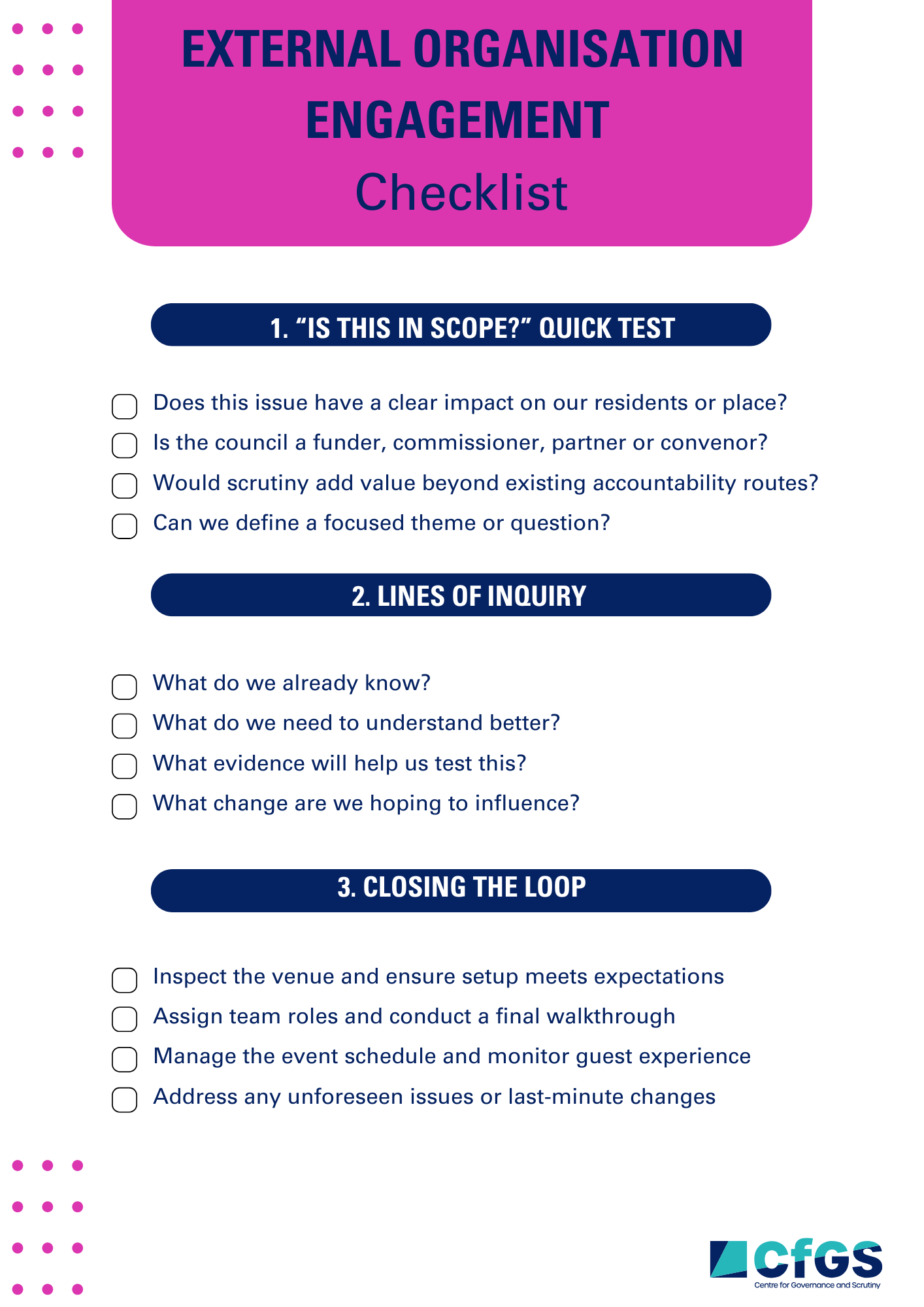
Useful questions include:
- Is there a clear local impact?
- What influence or leverage does the council have (directly or indirectly) and how might scrutiny help to extend that through public accountability?
- Will scrutiny add value beyond existing accountability mechanisms?
Being selective is a strength, not a weakness.
Reflective questions for committees
- Who really shapes outcomes on this issue?
- Where does accountability currently sit — and where is it missing?
- What does “success” look like for this piece of scrutiny?
- Are we the right body to lead this, or should we work with others?
Getting the right people in the room
Who an organisation sends to scrutiny matters.
For scrutiny to be effective, partners need to be represented by people who:
- Have sufficient seniority or authority
- Can explain decisions and trade-offs, not simply relay information
- Are able to respond to challenge and commit to follow-up
Where organisations send representatives who are unable to answer questions or influence outcomes, scrutiny risks becoming performative rather than productive.
Committees may wish to be explicit in invitations or pre-meetings about the level of representation they are seeking and why. This is not about hierarchy for its own sake, but about ensuring meaningful accountability and making best use of everyone’s time.
When partners won’t engage
Sometimes, despite best efforts, engagement does not happen. In these cases, committees can:
- Use evidence from regulators, inspectors or audits
- Work collaboratively across councils or regions
- Draw on community insight and lived experience
- Escalate concerns through formal reporting
In some circumstances, councils have also chosen to publicly note or challenge a partner’s refusal to engage. This can be a high-risk approach and should be used with care, but in certain contexts it has helped to prompt engagement by increasing public and reputational pressure.
Persistence and creativity often matter more than formal authority.
From scrutiny to impact
Scrutiny of partners should not end with a meeting.
Impact is strengthened when committees:
- Make clear, focused recommendations, including where these are directed at partners or external organisations
- Formally follow up those recommendations and track responses and progress over time
- Clearly report outcomes and learning
- Feed insights back into future work programming
- Close the loop with partners and communities
Transparent follow-up builds trust and demonstrates that scrutiny is about improvement, not point-scoring. CfGS’s practice guide on demonstrating impact provides further guidance on following up and tracking recommendations, including where these relate to external partners. (link to practice guide)
Tools and resources
Inviting external organisations
Checklist for scrutinising external organisations
Scrutiny's powers beyond the council and relevent partner authorities
Scroll through to see a list of scrutiny’s main powers outside the council, and which organisations it works with
 All resources