


Introduction
In local government, call-in refers to the ability of a scrutiny committee to review significant decision made by the executive (cabinet or delegated officer) before it is implemented.
What constitutes a significant decision should be set out by each council, and may include:
- Financial thresholds – for example, decisions involving expenditure above £100,000, £200,000, or £500,000.
- Geographical thresholds – for example, decisions affecting two or more wards.
In councils operating under an executive (leader and cabinet) model, a relatively small number of councillors are involved in day-to-day decision making. Call-in therefore acts as an important safety valve, enabling scrutiny members to challenge or request reconsideration of decisions before they take effect.
What this guide offers
This guide is designed for anyone involved in, or preparing for, the call-in process. It outlines legislative context, practical steps, and best practice for exercising call-in responsibly and effectively.
A word of caution
Call-in is a critical governance tool but should not be used as a political tactic. Excessive or partisan use can undermine its legitimacy.
Some constitutions set specific thresholds—for example, requiring three committee members to sign a call-in where there are only two opposition members—to ensure proportionality and prevent misuse.
Used judiciously, call-in strengthens accountability; used excessively, it risks obstructing effective decision-making.
What does the legislation say?
Although the term call-in does not appear directly in legislation, the Local Government Act 2000 provides the statutory framework for overview and scrutiny.
Under this Act, scrutiny committees have the power to:
- Review or scrutinise executive decisions.
- Review decisions made but not yet implemented.
It is this second power – the review of a decision prior to implementation – that forms the legal basis for call-in.
Through call-in, scrutiny committees may:
- Recommend that the decision be reconsidered by the decision-maker.
- Refer the matter to full council, particularly if the decision appears to breach the budget or policy framework.
Scrutiny retains its wider powers throughout, including access to information and the ability to invite cabinet members or officers to give evidence.
While call-in normally applies only to key decisions, councils may extend its scope in their constitutions. Some authorities also apply call-in to delegated officer decisions, where appropriate.
The legislative wording
(4) The power of an overview and scrutiny committee under subsection (2) (a) to review or scrutinise a decision made but not implemented includes the power:
a) To recommend the decision be reconsidered by the person who made it, or
b) To arrange for its function under subsection (2)(a), so far as it relates to the decision to be exercised by the authority.
c) To recommend the decision be reconsidered by the person who made it, or
d) To arrange for its function under subsection (2)(a), so far as it relates to the decision to be exercised by the authority.
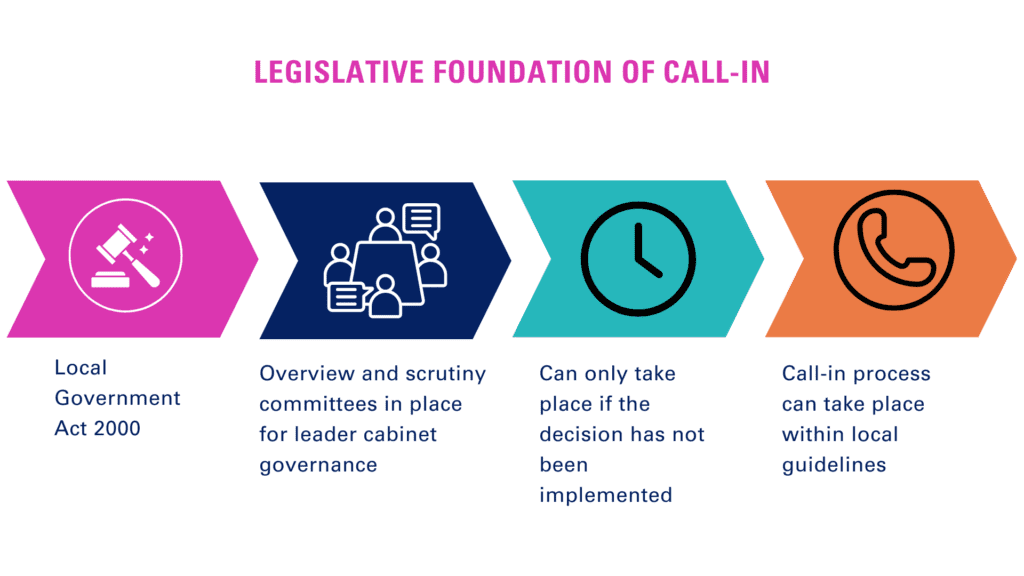
Legislative foundation of call-in
This outlines the legal and governance framework that enables the use of call-in within local government scrutiny:
- Local Government Act 2000
Establishes executive governance arrangements and overview and scrutiny committees. - Statutory basis for scrutiny powers
Overview and scrutiny committees are legally empowered to review and scrutinise executive decisions. - Restriction to unimplemented decisions
Call-in can only occur before a decision has been implemented. - Local constitutional framework
The call-in process is defined and operated through each local authority’s constitution and local procedures.
What is call-in for?
The legislation does not prescribe when or why call-in should be used. However, it is generally understood that call-in should be used sparingly and reserved for exceptional circumstances.
Call-in is a mechanism for scrutiny to send a clear, urgent signal to decision-makers that a decision may require reconsideration.
Typical reasons a council might use call-in include:
- Public contention: A decision has generated significant community concern
- Test rationale: Understand the thought process, and the alternative options that were considered
- Insufficient information or evidence: If there is a potential inaccuracy, lack of clarity or insufficient information perceived to have been used to justify the decision.
It is important to recognise that call-in temporarily pauses the implementation of a decision. While necessary for due diligence, this pause may delay projects and increase costs. Therefore, good governance seeks to avoid unnecessary call-ins by encouraging early engagement between executive and scrutiny.
Frequent use of call-in may indicate weaknesses in the scrutiny process or work programming. Conversely, if used constructively, it can strengthen transparency and build public trust.
Call-in is not
A political football to “make hay” – call-in should not be used just to score political points or bog down decision-making for partisan advantage. Call-in should not be a routine political tactic.
Used simply because you don’t like the decision – most councils’ constitutions require a valid reason (e.g., potential breach of decision-making principles) rather than mere disagreement. In some guidance, call-in rules specifically say it is not intended for general objections or dislike.
Used for post-decision scrutiny – call-in is a form of challenge before implementation, but it is distinct from broader post-decision scrutiny or performance review which can happen after implementation.

How do you exercise call-in?
Each local authority sets out its own conditions and procedures for call-in within its constitution. These can vary considerably.
To prepare effectively:
- Locate the rules — They may appear under executive decision-making or scrutiny procedure rules.
- Understand the criteria — The constitution should define what makes a call-in valid, including who may request it and how many members’ support is required.
- Check procedural guidance — Some councils have a separate protocol explaining timelines, roles, and validation procedures.
- Know the decision-makers — Usually, the Monitoring Officer determines validity; members who initiated the call-in typically cannot vote at the review meeting.
Clear, detailed guidance enhances both transparency and confidence in the process.
What does the process look like?
A) Decision notice published at least 28 days before the decision date.
B) Decision made by the Cabinet or relevant executive member.
C) Notification of the decision sent to the scrutiny chair (and sometimes all members) within two working days.
D) Five clear days follow for members to decide whether to call in the decision before implementation.
E) Request submitted. The Monitoring Officer checks it against the constitutional criteria.
F) If valid, a scrutiny meeting is convened within the prescribed timeframe.
H) Scrutiny meeting reviews the decision, takes evidence, and recommends one of the following:
- Implementation as planned
- Reconsideration or amendment
- Withdrawal.
I) Executive response. The Cabinet may accept, modify, or reject scrutiny’s recommendation. If the decision is deferred and re-listed, the call-in process resets.
Things to consider
Permissive call in
Where local details of how to trigger a call in are constructed to support a default ‘yes’ position where the role of scrutiny is valued and invited.
For instance:
– Any 5 councillors
– Or any chair of a scrutiny committee
– Or any 3 members of a scrutiny committee
– Them referring to the monitoring officer
High Threshold call in
This is where local rules appear to be constructed for a default position of ‘no’ perhaps
where the role of scrutiny is not perceived as high value.
For instance:
– 3 scrutiny members (where there are low numbers of scrutiny members) plus 2 from different parties
– And this would have to also include the scrutiny chair
What happens at a scrutiny call-in meeting?
Convened to meet statutory timescales. Or a meeting that is already in the diary
The relevant Cabinet Member and Chief Officer usually attend to provide evidence.
The Chair may invite other councillors, officers, or members of the public.
Information should be circulated early to enable effective questioning.
The committee may discuss recommendations at this point .
The committee votes on whether to support, amend, or oppose implementation.
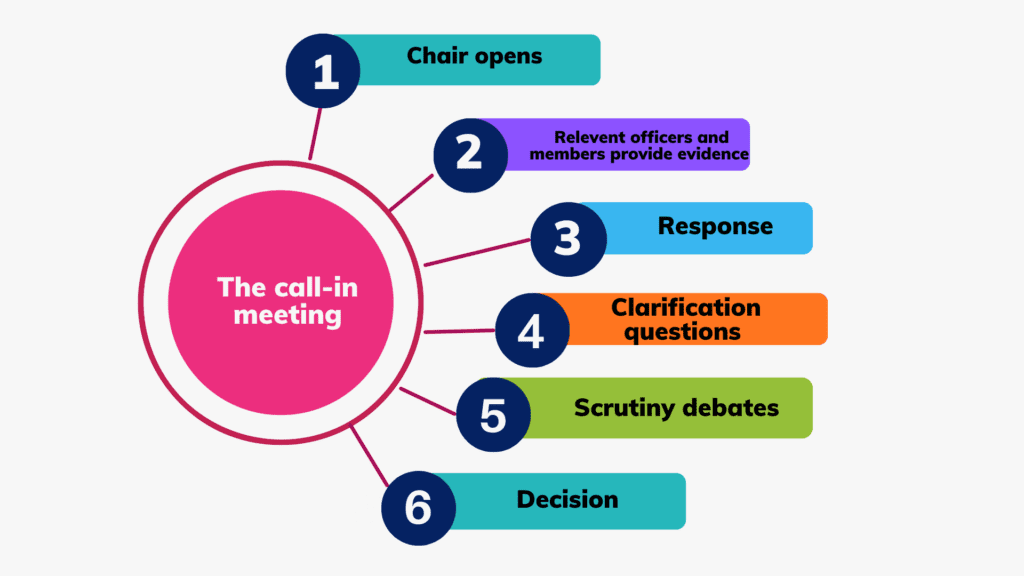
Chairs must be specific on what scrutiny member are voting on to avoid confusion
- Are you upholding the original decision? or
- Are you upholding the call-in and making a recommendation
Real life example of call-in
Coventry City Council
A decision had been made to remove some trees to make ways for a segregated cycle route.
There were some strong objections from a group of residents, who also tried to take the decision to a judicial review that was dismissed at the first stage.
The call-in was seen as being politically motivated by some, but it did provide the space for a wider discussion on the reasons behind the decision.
It also demonstrated to those residents with concerns that their concerns were being taken seriously, and there was going to be a second look at the reasoning for removal of the trees.
Resources

Download a PDF of this guide
 All resources