


Introduction
The local government sector is experiencing its most challenging period of financial jeopardy for more than 50 years. Rising cost pressures and declining incomes are growing the budgetary gap for many councils. If unattended, this will lead to more crisis and failure among councils. In this practice guide, we examine how financial scrutiny and governance can help councils to meet this unprecedented challenge.
Our guide encourages councils to place greater emphasis in their scrutiny work to the process of developing their Medium-Term Financial Plan (MTFP) and its role in ongoing revisions to the budget. The next annual council budget is always important, but as each yearly budget is embedded in the MTFP, it’s here that scrutiny can add most value.
What this guide offers
In this guide, we discuss how scrutiny can position itself in the mainstream of financial planning and become integral to the process. We encourage scrutiny committees to step back and assess where they can offer greatest value to the council and be an essential part of the governance of finance. It draws on existing CfGS publications on finance and treasury management and its partner organisations, together with current statutory guidance and lessons from recent government interventions.
How to use this guide
This practice guide is designed for councillors, scrutiny officers and committee chairs. Each section offers practical tools, checklists, case studies and templates.
The medium term financial plan
Councils have a best-value duty under the Local Government Act 1999. They are expected to consider their budget, corporate plan, and medium-term financial plan together. Government guidance and sector good practice recommends for councils to have a medium-term financial strategy covering at least three to five years. So, the medium-term financial plan (MTFP) is a way of planning resources to deliver its council strategy and continuous improvement. In practice, it’s a strategic tool to allow councils to explore its future risks, pressures and opportunities and try to ensure that it has robust plans to manage them.
But because it has a medium-term perspective, scrutiny is often given a limited role, when in fact it can add significant value in scrutiny of the assumptions, predictions and assessments in the draft plans. Instead, scrutiny resources are perhaps too often dedicated to superficial oversight and comment on a draft annual budget, presented in December or January where the contents have been largely decided and fixed, offering scrutiny to make only retrospective comment on a budget that is arguably already decided.
Effective scrutiny of the council plan and its associated resourcing plan, the MTFP, is central to the sustainability and legitimacy of a council. Members need to engage in testing priorities and choices, understand risk and service pressures, and seek assurance that the assumptions upon which the financial plan is set are realistic and robust.
Roles and governance: who does what?
Both scrutiny and audit have important roles and responsibilities regarding a council’s budget setting and its delivery.
Scrutiny
Scrutiny plays a vital role in council budget development by ensuring transparency, accountability, and democratic oversight throughout the planning and decision-making process. Unlike audit, which typically occurs after financial decisions have been made and implemented, scrutiny is proactive and forward-looking. Scrutiny committees have the task of examining budget proposals to challenge assumptions, and assess whether spending plans align with strategic priorities and community needs. Their work helps shape the budget before it is finalised, offering recommendations, highlighting risks, and ensuring that diverse perspectives are considered. This process fosters informed debate and can lead to more equitable and effective resource allocation.
Audit
In contrast, the role of audit or the audit committee is retrospective and compliance-focused. Audit committees review financial statements, monitor internal controls, and assess whether public funds have been used appropriately and in accordance with legal and regulatory frameworks. Their primary concern is financial integrity and risk management, not policy direction or strategic alignment. While scrutiny seeks to influence what the council plans to do, audit evaluates what the council has already done and seeks assurance that appropriate controls are in place. Together, these functions provide an important set of checks and balances – scrutiny exploring and shaping and audit safeguarding. Governance responsibilities extend to cabinet and statutory officers within the council. To provide some clarity, these are summarised here.
Key roles in council finance governance
Scrutiny
Purpose: Political oversight, pre-decision challenge, shape and improve, public accountability
Focus: Corporate priorities and alignment to budget plans, risk, value, impact on residents
Core outputs: Recommendations and reports from committee or task group findings
Interface with others: Work with audit, tracking finance progress, avoid duplication or gaps. Cabinet two-way on information and tracking
Audit committee
Purpose: Independent assurance on governance, risk and controls, financial reporting quality, risk, culture, compliance and controls
Focus: Internal audit plan, external audit, VFM arrangements, compliance and risk recording
Core outputs: Reports from internal audit, risk register, annual governance report, commentary on compliance
Interface with others: Referral interface protocol with scrutiny on findings, signposts, emerging risks and potential areas for scrutiny enquiry
Executive/cabinet
Purpose: Policy development and leadership, align purposes and resources with corporate plan. Sets priorities, agrees trade-offs and delivery plans
Focus: Corporate plan, medium term financial plan (MTFP), capital plan/balance sheet and treasury strategy
Core outputs: MTFP, annual budget, delivery plan, savings and efficiencies and transformation plans
Interface with others: Early engagement with scrutiny, provide access and information. Acting on audit reports recommendations and improvements
Section 151 officer
Purpose: Professional advice, financial stewardship; prevent unlawful expenditure; statutory reporting duties
Focus: Ensure efficient and proper use of funds; governance and strong financial systems
Core outputs: Financial strategy to assist council delivery its plans; balanced budget and achievable medium term financial plan
Interface with others: CEO, monitoring officer, cabinet, scrutiny, council and members; audit and treasury
Developing a scrutiny plan
Too often we see scrutiny of finance as superficial, unstructured and feeble. It is too often ill-prepared and under-informed and is unable to perform much more than a random or cursory exercise that offers little value other than a tick in the box.
To be effective, scrutiny needs a plan. This plan needs to set out goals, organise a strategy and arrange all the pieces necessary to carry out a deeper exploration and, crucially, to carry out a useful set of scrutiny tests, that will:
- positively contribute to the budget and MTFP planning process
- provide an extra layer of assurance
- make recommendations and advice based on its findings
We’ve developed a core structure below to help scrutiny to organize itself and conduct its scrutiny enquiries through a structured plan.
Who and when
The MTFP is a continuous ‘live’ document that refreshes annually as the next year’s figures are added and the plan moves further into the future. So when should scrutiny begin its work? Sometimes, it’s advised that this work cannot start until virtually all the budget figures have been assembled and a draft is available. But then the council decision to approve the new MTFS and latest annual budget usually happens just a few short weeks after a final draft is produced in late December or early January. So, is involving scrutiny at this stage too late in the process? Scrutiny at the 11th hour rarely offers any real contribution. Many councillors who share their experience say that there is too much information and not enough time to understand its complexity let alone scrutinise it.
To do its job, scrutiny needs to work further upstream, potentially months before the final draft is produced. It can then focus on the integrity of the construction rather than glancing at the finished product.
Starting sooner gives scrutiny the scope and space to contribute constructively to the process. It can help to test out the assumptions, foundations, options, risks, pressures, savings plans and policy choices, seeking assurance that financial plans and choices will deliver corporate priorities.
In most councils the constitution determines which scrutiny committee gets the task of scrutinising the budget. But, increasingly, because this is a realistically a bigger task than can be accommodated into a couple of committee meeting agendas, a task group, working group or sub-committee is appointed.
A sub-group offers a number of advantages:
- it can focus on a single task
- it can meet and work in a non-public space (but report in public)
- it foster an accumulation of knowledge and expertise
- it has its own space and time
- it has the ability to handle sensitive information**
- it can offer a public report to its main committee and recommendations to cabinet
Such groups will need support, officer time, expertise, information and access – and have active cabinet and corporate leadership agreement and support – in order to be successful. They also benefit from a dedicated finance officer to support and advise.
Membership of a task group (or sub-committee) is obviously down to the relevant appointing committee or constitution, but it’s not essential to select from those with a finance bent. This is because the task for finance scrutiny – despite its name – is not to scrutinise finance, but to scrutinise the narrative and operating environment that drives financial decisions.
As a result, people with curious minds and an interest in the council’s critical mission and the challenges it faces can make excellent finance scrutineers. As with all scrutiny, however, to get the best out of the process, it needs to operate in a politically neutral way. This will prevent the process from losing trust. The political punch-up, if that is desired, can happen later at full council.
**Understandably cabinet members and possibly officers can become nervous about sharing budget information, especially early in the process. It’s absolutely essential that there is a clearly understood protocol about how information is used. Obviously, cabinet needs a safe, non-public space to consider its options and difficult choices before formal proposals are finalised. That is not an area for scrutiny. But scrutiny will need to be let in at some point during this process and have a legitimate role in exploring subsequent choices and draft decisions.
The council corporate plan
Corporate (council) plans provide a strategic framework for councils to set and achieve their objectives and to help meet their best value duties. While they are not compulsory, they are widely regarded as best practice. Such plans should therefore be at the core of the budget scrutiny process.
The corporate plan is agreed by full council and sets out the strategic direction, ambition, intentions and key deliverables for the lifespan of the plan and its subsequent revisions. The medium-term financial plan (MTFP) should therefore align with the corporate plan, as this sets out the way council resources will need to be applied to support its delivery and operation.
The scrutiny task is therefore to understand the corporate plan (which has hopefully been extensively scrutinised before approval by council) and to rigorously test that the MTFP is able to support it. Corporate finance has to support the strategic plans and essential investment in services through its capital planning and allocations as well as resourcing day-to-day operations and council running costs. Without this connection to the corporate plan, scrutiny of the MTFP in isolation makes little sense.
Work programme and timing
Scrutiny of a council’s finances, budget and MTFP is an integral part of governance. It therefore should run parallel with the budget-setting process and align with the key milestones in setting the budget. This means that it needs to be integrated into the committee’s annual work plan and any task group or similar arrangement agreed and organised as part of work planning.
The timeline below suggests a timetable and activity schedule for scrutiny. Gaining the advice of the council’s senior finance officer, (section 151 officer) can help to ensure that timings are achievable and resources to support this are made available. The schedule recommends starting early and embedding scrutiny into the process. It sets out time to enquire into cabinet member plans for budget savings or ideas for service transformation, plans to manage pressures or necessary new spending. And it allocates time for the scrutiny team to reflect and build its recommendations to cabinet.
Timeline for budget/MTFP scrutiny
September
Actions:
- Scrutiny agrees format (task group, membership).
- Briefing by finance director (Section 151).
October
Council milestone: Cabinet considers options.
Actions:
- Further briefings and planning.
- Scrutiny agrees objectives and plans strategy.
- Meet cabinet to discuss scrutiny plan and cabinet role.
November
Key event: Government autumn budget.
Council Milestone: Early draft budget.
Actions:
- Set up enquiry sessions with individual cabinet leads and officers.
December
Key event: Government financial settlement.
Council milestone: know figures now included.
Actions:
- Set up further enquiry sessions with individual cabinet leads and officers.
- Sense-making session: discuss findings and recommendations.
January
Council milestone: Final budget draft.
Action:
- Present report to cabinet and discuss findings and recommendations.
February
Council milestone: Council agrees budget.
Action:
- Cabinet issues formal feedback to scrutiny and explains actions taken or intended.
March
Council milestone: Council tax demands issued.
Action:
- Relevant scrutiny committee reviews the outcome and considers future improvements.
Setting scrutiny’s purpose and objectives
Having a structured approach allows members to ensure that they have understood the essential issues of the budget and MTFP and have a collectively agreed plan to explore and constructively challenge these issues. The appropriate scrutiny committee will need to agree how this will be delivered, such as a whole committee task or a task and finish group or a sub-committee (where the constitution allows).
The objectives therefore could include:
- Test whether the MTFP is realistic and based on sound assumptions (economic, social, etc)
- Challenge the risks and pressures factored into the budget and their validity
- Ensure the MTFP supports council’s strategic aims, service plans, and statutory
- Explore any budget gaps in MTFP in future years and the robustness of plans to close them
- Assess whether planned savings and investments are deliverable and their impact on services or priorities
- Seek assurance on financial resilience, including reserves, contingencies, and exposure to risk. Aim to produce clear, evidence-based recommendations to cabinet or full council.
Scope
Focusing in closer, the scrutiny mission needs to concentrate on areas where it can make a productive difference – being curious and using its collective voice and insight, but not trying to design the budget itself or getting entrenched in micro managing. Scrutiny is therefore exploring critical areas of the budget such as:
- Revenue budget projections and funding assumptions over the MTFP period (income, council tax, government grants and other income streams)
- Pressures and growth areas in high-risk/high spend services (e.g. children’s services, adult social care, temporary accommodation).
- Savings proposals, transformation programmes, and demand management plans
- Use of reserves and the adequacy of the council’s financial resilience
- Capital programme, borrowing strategy, and impact on the revenue position
- Risks and mitigations, including scenario planning and sensitivity analysis.
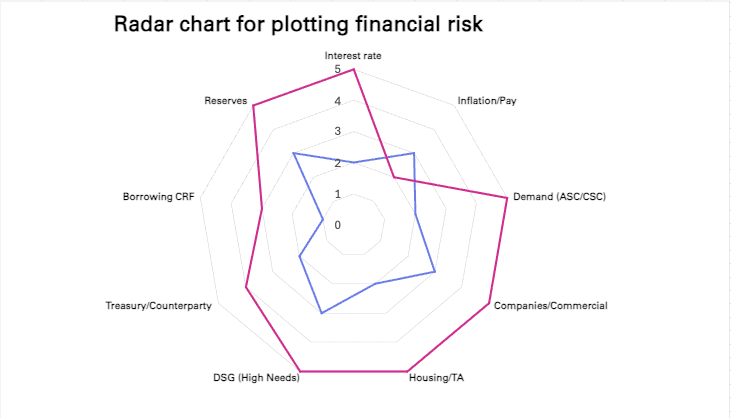
The following risk radar can help scrutiny to plot out the areas that may have highest risk for the budget/MTFP and thereby to agree a suitable focus. The spider graph can be adjusted to set your council’s specific detail and scoring.
Risk radar
We have shared an downloadable Radar chart that can be used to create a simple risk radar. This picture illustrate the graph that this produces.
Key lines of enquiry (KLOEs)
Effective scrutiny of the MTFP and budget is a big task and there is plenty to organise and think about. We suggest breaking down scrutiny into particular lines of enquiry. A task group is likely to need meetings over a number of weeks to address all of these, starting in October and ending with a report in January for example. in such a case, it would be useful to allow time for a session with the main committee (if working through a task group or sub-committee) and time for Cabinet to give full consideration of a final report prior to them giving their feedback to scrutiny.
To structure the sessions further we have offered a way to collate the key issues to provide a line of enquiry for each, these are:
Strategic fit
- Does the MTFP clearly link to the council’s corporate plan and political priorities?
- How are key strategic ambitions resourced in the plan?
- Are there areas where spending is misaligned with stated priorities?
- What are the opportunity costs (what isn’t being funded)?
Financial sustainability
- Are funding assumptions (grants, council tax, business rates, fees and charges) evidence-based and realistic?
- Are other economic (inflation, interest rates, payroll costs, etc.) and government policy assumptions realistic? Are they in line with other similar councils?
- Is there any reliance on one-off funding (e.g. reserves, windfalls)? If so, is this increasing or reducing?
- Is council borrowing affordable? what is the impact on revenue budget?
- Does the MTFP maintain a balanced position for each year, not just Year 1? What plans exist to close any gaps?
- How resilient is the council to unexpected shocks (economic downturn, service demand spikes)?
- How would different ‘worst case’ scenarios affect financial sustainability?
- What commercial investment risks does the council hold and is the governance and scrutiny of these investments regularly reviewed to ensure it complies with good practice?
Deliverability of savings and efficiency plans
- Are savings clearly defined, costed, and owned by a cabinet member and senior officer?
- Are transformation or demand-reduction savings achievable at the pace assumed?
- What is the track record of similar savings in previous years?
- Are there realistic plans, resources and expertise available for transformation, savings or demand management
- Are there any invest to save proposals and are these backed by a realistic business case?
Service impact and risk
- What is the impact of proposals on statutory duties, vulnerable residents, and corporate priorities?
- Which service areas face the largest pressures or overspends and how is this being mitigated or managed?
- Are demand-led pressures (e.g. SEND, social care, homelessness) fully recognised?
- How are red-rated financial or service risks being mitigated?
- How are outcomes monitored and evaluated over the life of the plan?
- Are equality, fairness, and social value considered in financial planning?
- Is there a good understanding of the council’s cumulative risk?
Note about Statutory services:
Statutory services should not be excluded from scrutiny or a drive for greater efficiency and productivity. We have come across situations where certain services feel protected or immune from budget scrutiny and challenge. It can often be of immense value to statutory services to be rigorously scrutinized and their spending challenged. There are instances where high spending does not equate to high service quality or value, so challenge can actually add value.
Reserves and resilience
- Are reserves at an appropriate level, given identified risks?
- Is the Council using reserves to fund recurring spend — and if so, what is the exit plan?
- Has there been any audit advice regarding level of reserves?
- Are specific ‘earmarked’ reserves still appropriate or needed?
- How sensitive is the position to inflation, pay awards, or interest rates?
Capital programme and borrowing
- Is the capital programme affordable and deliverable within capacity?
- Are borrowing costs and MRP prudently built into forecasts?
- Do capital projects create future revenue pressures? Are they funded in the MTFP?
- Is there an asset disposal programme linked to capital plans and is this delivering on schedule?
Planning and preparation
Click the buttons to see more
Briefings from the Section 151 Officer on key assumptions, funding gaps, and risk outlook etc.
Scheduled focused sessions on high-risk services, inviting relevant portfolio holders and officers.
With relevant cabinet member and officer on areas of transformation, savings and demand management.
Into performance information on high spend and high risk service areas. In collaboration with Audit Committee examine the financial risk register.
Ensure key messages are understandable and feedback is incorporated.
Sense-making, outputs and recommendations
The scrutiny should conclude with reflective thinking to draw out learning, to apply in subsequent or follow-up work. In order to make useful and compelling recommendations, sense making should be:
- Strategic – looking at the significant areas that may have greatest value and impact
- Not operational – avoid tinkering with detail of service issues, or issues that are effectively small fry
- Non-political – this is not a fault-finding or point scoring exercise
The end product should be a brief report outlining the work undertaken and the points scrutiny believes cabinet should consider. Typically, (but you will discover your own) this might include consideration of:
- Sustainability concerns, such as doubts about assumptions, savings plans etc – perhaps recommending cabinet to seek further assurance or factor in extra contingency
- Over-optimism – similarly where savings or changes are based on the delivery of a plan – perhaps recommending that cabinet ensure that there is sufficient grip of those areas scrutiny wishes to highlight
- Capacity and resources – recommending that cabinet checks that Council has the ability to deliver any ambitious plans where under-delivery could affect the MTFP
- Income forecasts – should scrutiny discover that past performance has been over stated, it may recommend additional caution, for example
- Reserves and borrowing – recommendations could, where appropriate, draw attention to weaknesses or risks and recommend further assurance
- On-going monitoring – recommendations focusing on areas for further monitoring, for example where there are possible demand fluctuations or economic uncertainty
Finally, the scrutiny report is to be considered by cabinet in advance of a decision to approve the budget and MTFP for acceptance by full council. Therefore, it should be clear and succinct with insightful observations and useful recommendations. But it should not a set a tone with instructions or demands of cabinet. It should be welcomed and appreciated as a considered and helpful asset to the budget setting process.
Member support and capacity
Effective scrutiny depends on clear, accessible information and confident members. Councillors must be equipped with concise briefing packs that explain key financial issues, assumptions, and risks in plain, jargon-free language.
Finance officers and democratic services teams should ensure that all reports include clear executive summaries, highlight key messages, and avoid unnecessary technical complexity. This support can help councillors to focus on the strategic implications of financial information rather than the technical detail.
Targeted training and development are also essential to build councillors’ financial awareness and confidence. Strengthening understanding of how medium-term financial planning works and how budget setting fits into the process. And to equip scrutiny to provide informed, independent challenge and to contribute meaningfully to improving the council’s financial governance, resilience, and value for money.
Capital, treasury management and assets
Scrutiny plays a vital role in adding value to the Capital Strategy, Treasury Management Strategy, and Investment Strategy, by providing independent oversight, challenge, and assurance.
Through detailed examination of these strategies, scrutiny members can ensure that financial decisions are transparent, evidence-based, and aligned with the council’s long-term priorities and risk appetite.
By questioning assumptions, testing affordability, and assessing how capital and investment plans contribute to local outcomes, scrutiny helps strengthen financial resilience and accountability. This process not only enhances public confidence in how resources are managed, but also supports better-informed decision-making that delivers sustainable value for money for residents and communities.
It can be quite a technical area and we recommend that scrutiny is supported by officers to ensure that has the capacity to engage with this highly important area of finance governance. For further help and study, it would be useful to draw on the guidance within the CIPFA Prudential Code and Treasury Management Code and scrutiny guidance in published CFGS publications.
Scrutiny and monitoring of the annual revenue and capital budgets
Scrutiny has a vital role in providing ongoing oversight of the council’s financial performance throughout the year, not just during the annual budget-setting process. By reviewing quarterly budget monitoring and outturn reports, scrutiny can assess whether spending and income are on track, whether savings plans are being delivered, and whether emerging pressures are being effectively managed. This ensures that councillors maintain visibility of the council’s financial health, and can identify early signs of risk, such as overspends in demand-led services or slippage in savings programmes. Regular scrutiny of quarterly reports allows early course correction and evidence-based recommendations before year-end decisions.
The committee’s focus should be on understanding why variances have occurred, the realism of corrective actions, and the wider service or policy implications of financial trends. Scrutiny should challenge both short-term fixes and longer-term sustainability, testing, whether actions align with the council’s strategic priorities and Medium-Term Financial Plan. The aim is not to replicate the work of finance officers, but to provide independent, transparent challenge that strengthens accountability and promotes sound financial management across all services.
Commercial activity, companies and partnerships
Some councils have established trading companies, joint ventures, or investment vehicles to deliver services, promote regeneration, or generate income. While these arrangements can bring innovation and flexibility, weak governance and limited oversight can lead to major financial and reputational risks.
Scrutiny plays a vital assurance role – ensuring clarity of purpose, transparency, and proportionate risk-taking in all commercial activity. But it’s important to recognise that scrutiny will have boundaries, where commercial confidentiality is necessary.
Scrutiny’s role is centred on ensuring that the council’s objectives are met and that the governance arrangements are clear and accountable. In addition to scrutiny, there is also a role for audit in assuring that governance is working effectively and risk is managed appropriately. The Local Authorities Trading Companies guidance will also be a useful reference guide for scrutiny: https://localpartnerships.gov.uk/resources/latco-guidance/.
Some key principles for scrutiny of commercial activities
- Public value: Commercial activity must serve the council’s strategic objectives and community outcomes
- Clear accountability: Roles of council, shareholder, and company board must be distinct and documented
- Transparency and assurance: Members need access to timely, comprehensible performance and financial data, but not information which if public would expose risk for the venture
- Active risk management: Councils must understand and control their total exposure
- Exit readiness: Every venture should have a plan for recovery or withdrawal
Alternative budgets – overview, pros and cons
We have included this section on alternative budgets as they can cross paths with scrutiny, although generally it is not the role of scrutiny to become involved in what might be an area of political policy exchange. Robust scrutiny with a clear set of compelling recommendations can provide many of the tests and challenges that render alternative budgets unnecessary. But in some councils alternative budgets are a familiar part of the budget debate.
And, typically developed by opposition groups, alternative budgets can provide an opportunity to present a different set of policy choices and spending priorities from those proposed by the cabinet.
In this way, they can enhance transparency and democratic debate by showing how the council’s resources could be allocated differently to achieve alternative outcomes. When well-prepared, they can also demonstrate constructive challenge and can test the robustness of the administration’s assumptions.
They also provide councillors and the public with a clearer understanding of trade-offs between competing priorities and fiscal constraints, helping to strengthen the overall quality of financial scrutiny. All alternative budgets must also be signed off by the section 151 officer to confirm they are lawful and financially balanced.
However, alternative budgets also present challenges. They can be resource-intensive to produce, requiring detailed financial modelling and assurance from the section 151 officer that proposals are lawful, balanced, and deliverable.
Time pressures – particularly when the alternative must be prepared alongside the main budget – can limit the scope for evidence-based analysis. There is also a risk that alternative budgets become primarily political statements rather than technically robust financial plans, especially if underlying assumptions are not tested with officers.
To be effective, alternative budgets should therefore be planned and developed early, underpinned by accurate financial data, and framed as a credible contribution to the council’s financial debate rather than a purely oppositional exercise.
What scrutiny needs to know
As a set of reference points for councils and scrutiny to take into account as it thinks about its scrutiny framework. It is important for scrutiny to draw on these important national publications for guidance and direction.
The government refreshed statutory guidance on overview and scrutiny in April 2024, and set out Best Value standards in May 2024. Scrutiny must have regard to both when shaping practice.
Conclusions
Providing assurance in the budget building process is key to scrutiny’s role. Residents and other stakeholders should be able to feel confident that the money spent to provide local public services has been subject to objective, robust challenge. The Cabinet can also add this extra assurance when it recommends the budget package to the meeting of full Council. Therefore, done well, scrutiny can make a significant, and essential contribution to council governance and its financial wellbeing.
Media assets to download
You can download these assets here: Finance scrutiny assets and tables
Case studies and background information
There are examples of great practice from councils across the country. We have also included reports as background reading on aspects which are worth taking into consideration:
Brent (2025): Budget Scrutiny Task Group
- Budget scrutiny task group report outlining annual, portfolio-based deep dives and recommendations to cabinet: https://democracy.brent.gov.uk/documents/s147391/08a.%20Appendix%20A%20-%20Budget%20Scrutiny%20Task%20Group%20Report%20Updated%20Final.pdf
- Cabinet budget and council tax report referencing scrutiny input: https://democracy.brent.gov.uk/mgAi.aspx?ID=72162
Westminster (2024): Budget Scrutiny Task Group
- Public reports pack examining the general fund, HRA and capital programme: https://committees.westminster.gov.uk/documents/g6683/Public%2Breports%2Bpack%2B04th-Dec-2024%2B18.30%2BBudget%2BScrutiny%2BTask%2BGroup.pdf?T=10
- Summary report of budget scrutiny task group findings: https://westminster.moderngov.co.uk/documents/s64642/Appendix%202%20-%20BSTG%20Summary%20Report%20-%20February%202025.pdf
St Helens (2025): Finance Scrutiny Task Group
- Financial monitoring reports considered quarterly by overview and scrutiny commission: https://www.sthelens.gov.uk/article/5601/Financial-Monitoring-Report
- Finance scrutiny and budget-related appendix papers: https://sthelens.moderngov.co.uk/documents/s170498/Appendix%201.pdf
Thurrock (2023): Best Value Inspection
- Government best value inspection report for Thurrock Council: https://www.gov.uk/government/publications/thurrock-council-best-value-inspection-report
- Annual governance statement referencing vest value findings: https://www.thurrock.gov.uk/sites/default/files/assets/documents/thurrock_councils_2023-24_annual_governance_statement.pdf
- Council statement on publication of the best value inspection report: https://www.thurrock.gov.uk/news/government-intervention/statement-on-publication-of-best-value-inspection-report
References
1. CfGS, 2020, Financial Scrutiny Practice Guide.
2. CfGS, 2023, Financial Scrutiny: A Guide for Members.
3. CfGS, 2024, Treasure Your Assets: Scrutiny of Treasury Management.
4. CfGS, 2021, Audit Committees and Scrutiny Committees: Working Together.
5. CfGS, 2024, Audit, Scrutiny and Risk.
6. DLUHC/MHCLG, 2024, Overview and Scrutiny: Statutory Guidance.
7. DLUHC/MHCLG, 2024, Best Value Standards and Intervention: Statutory Guidance.
8. MHCLG, 2024, Addressing the Local Audit Backlog: Consultation Outcome – Backstop Dates.
9. PSAA, 2025, System Updates and Quarterly Bulletins.
10. DLUHC/MHCLG, 2025, Audit Build-Back Grant: Technical Note.
11. DLUHC/MHCLG, 2025, Overhaul of Local Audit Will Restore Trust.
12. National Audit Office, 2025, Local Government Financial Sustainability.
13. Local Government Association, 2017, Councillor’s Workbook on Scrutiny of Finance;
Local Government Association, 2024, Councillor’s Workbook on Local Government Finance.
14. CIPFA, 2021, Prudential Code for Capital Finance and Guidance Notes.
15. CIPFA, 2021, Treasury Management in the Public Services Code and Guidance Notes.
16. CIPFA, 2019, Financial Management Code and Implementation Guidance.
17. CIPFA, latest releases, Financial Resilience Index and Local Context Guidance.
18. UK Government, 2020-2025, Best Value and Public Interest Report Case Studies: Nottingham (2020), Slough (2021-2025), Thurrock (2023), Woking (2023-2025).
19. CfGS, 2024, Relationships for Effective Governance and Scrutiny.
20. Various local authorities and Local Government Association, 2024-2025, Budget Task Group Case Materials: Westminster (2024), Brent (2025), St Helens (2025), Peterborough (LGA case studies).
 All resources