


We share roundups of our experts' presentations from our learning event on the divide between audit and scrutiny
In our learning event Shades of Grey we asked a panel of experts – Councillor Nick Wayne (Islington), Councillor Anna Lynch (Hackney), and Professor Laurence Ferry (Durham University) – to share their own perspectives on these questions.
Speaker reflections
Councillor Nick Wayne (Islington)
Councillor Nick Wayne has represented Canonbury ward in Islington since 2014. He has chaired the Audit Committee and is now the chair of the Corporate Resources and Economy Scrutiny Committee. Outside of council work he is a barrister specialising in criminal law.
Nick shared his own journey through both audit and scrutiny in Islington, reflecting on how they are different and how they complement each other.
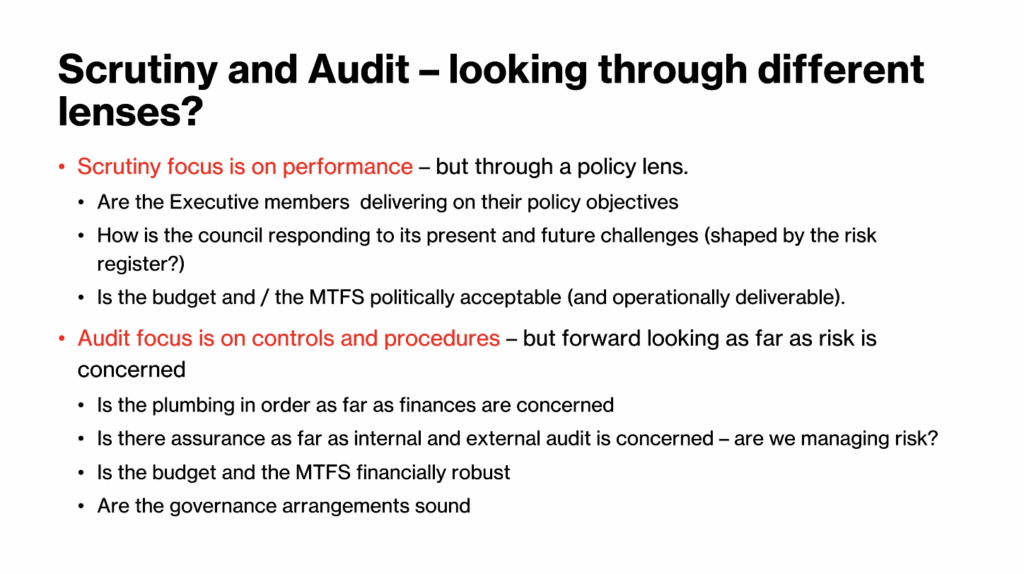
For him, audit is about systems, controls and risk: “Audit looks at systems. It looks at controls. Is the plumbing right?” While scrutiny, by contrast, is about political accountability: “Are executive members delivering on their policy objectives? How is the council responding to its present and future challenges?”
He shared this excellent slide to summarise those differences…
But, despite the obvious differences, there are important overlaps. “Audit committees should be looking at, for example, fraud risks, approval of council tax basis, whistleblowing, and inevitably, once you have a committee that looks into those areas, there is an overlap with the scrutiny function.”
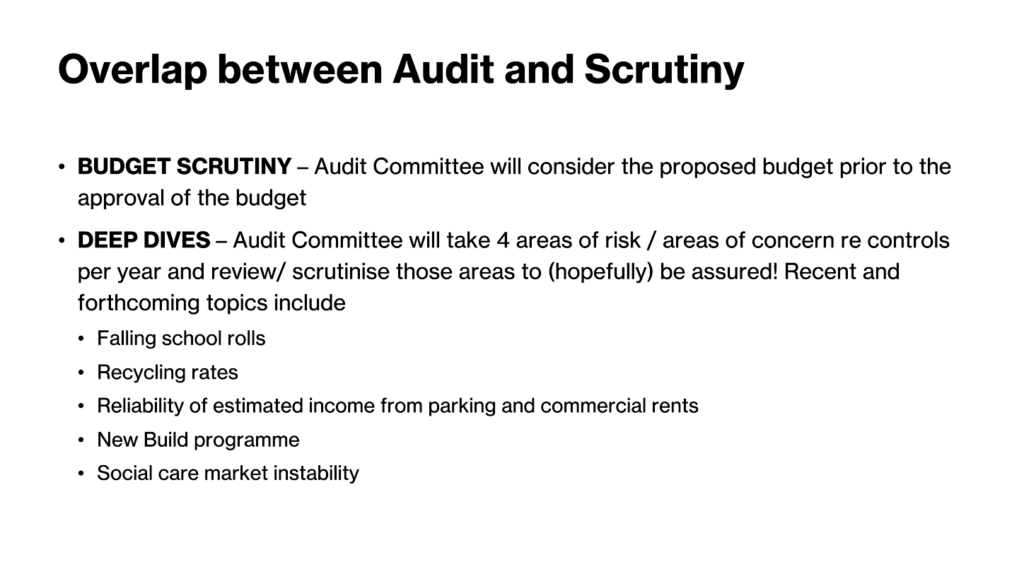
In terms of how the two functions should work together, Nick said that when he had been a chair of audit committee he’d consciously conducted something of a ’land grab’ on scrutiny. ”That was perhaps in part because Islington at the time was such a one party state, and there was perhaps a vacuum as so far as financial scrutiny was concerned, and that’s why, going back to where I started, I think the relationship between audit and scrutiny can be quite authority specific, and inevitably it depends on the personalities, and chairs.”
Now Nick enjoys an excellent working relationship with his counterpart chair of audit. “We have monthly meetings with the lead member for finance, so that there is a common approach, and there’s also reasonable overlap between the composition of the audit committee and the lead scrutiny committee, and my view is that helps in ensuring that there isn’t duplication, but there is a complementary approach to financial scrutiny.”
Councillor Anna Lynch (Hackney)
Councillor Anna Lynch represents Homerton ward in Hackney and chairs the borough’s Audit Committee. She explained that the council has an audit committee, and several scrutiny commissions. Thanks to her background – she is a registered nurse and has worked at a senior national level in the NHS – Anna already had a good understanding of the differences between audit and scrutiny before becoming a councillor.
She said that audit is often undervalued, and sometimes seen as the “Cinderella” of committees. Scrutiny, in contrast, allowed councillors to “really get under the bonnet” – and there were examples where this had led to changes to existing policy, or even new policies had been developed.
Nonetheless the value of audit was in its statutory power – sitting outside the political cut and thrust, and providing a clear, non-political assurance.
“It’s very much around the systems, the controls and making sure that we’ve got that evidence that the council is doing the things the right way,” she said.
While CIPFA and CfGS recommend that audit and scrutiny remain clearly separate, Anna said their work should be aligned.
In Hackney audit and scrutiny collaborate through regular joint budget sessions. Every six weeks, the chair of audit, the chair of scrutiny, the Section 151 officer (statutory responsible financial officer) and the cabinet lead meet in to carry out “sense checks” on the council’s financial position.
She gave a specific example of how scrutiny and audit could combine. Hackney’s Audit Committee identified financial risks in local schools caused by falling pupil numbers – a trend driven by post-Covid changes, the cost of living, and rising accommodation costs in London. Audit picked up the issue of financial stability, but then passed it to the Children and Young People Scrutiny Commission. Scrutiny was able to explore the wider educational and community implications – doing the “more meaningful, granular” work, bringing in parents and experts – and coming to decisions about the viability of some schools.
Professor Laurence Ferry (Durham University)
Professor Laurence Ferry is Professor in Accounting for Democracy at Durham University Business School. He is a Fellow of CIPFA, a chartered accountant, and a leading academic voice on audit and accountability.
He said that to really understand how audit and scrutiny contribute differently to accountability it’s best to ask a different question: how do we treat accountability and transparency differently?
Since 2010, government has reduced accountability while promoting transparency measures such as publishing data and hoping citizens could act as “armchair auditors.” Something he said hadn’t materialised.
“From about 2010 was a move towards more transparency and less accountability… making more information or data publicly available… became a surrogate for proper accountability,” he argued.
Transparency had not proved a genuine substitute for what he called “proper accountability”. In other words, “proper public audit and proper performance management data.”
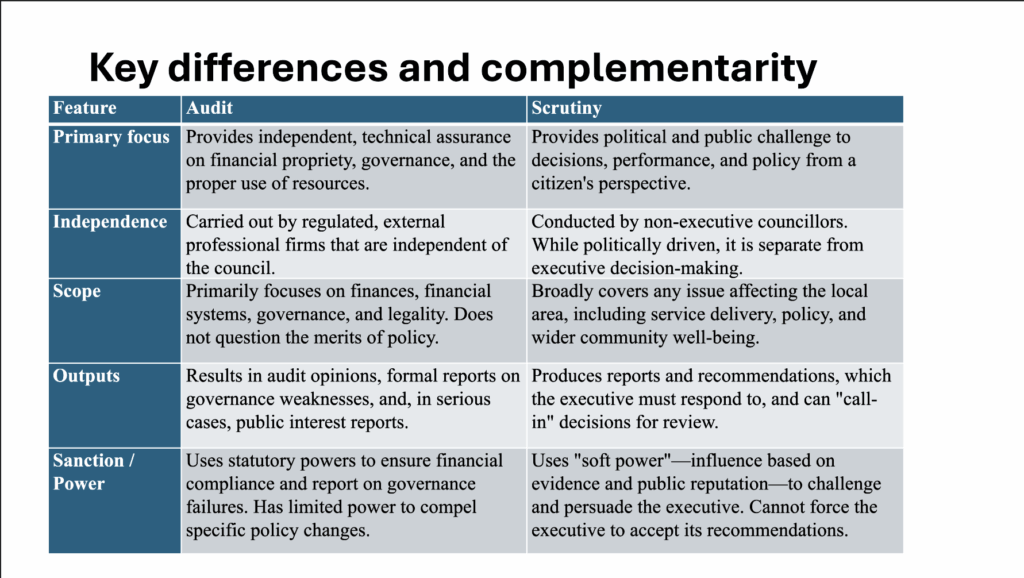
Audit and scrutiny have been on different journeys. The Poulson scandal in the 1970s helped drive government to a centralised assurance system to prevent corruption. This centralisation would lead to the Audit Commission, which between 1983 and 2015 looked at whether councils were delivering value for money. But the system was swept away in the 2010s to be replaced by “a fragmented, largely privatised system”.
That only considers “whether [value-for-money arrangements] are in place, not whether they are actually delivered”.
The result, he argued, is a system in crisis: “We know this privatised model has ultimately failed. There’s a new crisis now, the systemic failure. There’s audit backlogs and the financial instability of local government goes without saying.”
Scrutiny, by contrast, is tied to the policy-making process, testing decisions and services in a forward-looking way: “[It] evaluates the council services and policies and decisions, as well as the executive’s plans and performance… its purpose is to inform decision making.”
But here too, Laurence pointed to weakening capacity: “Ongoing austerity… has impacted on local government scrutiny, basically because there has been funding cuts, and therefore decline in the amount of dedicated staff.”
Both functions have been undermined by structural changes in the last 15 years – audit by privatisation, scrutiny by austerity. What is needed now is reform and reinvestment: “There definitely needs to be a professionalised public audit with financial and performance related aspects… and scrutiny has to be properly resourced.”
Audit and scrutiny workshops
If you enjoyed this content and are a scrutiny and/or audit chair you can attend one of our free, practical workshops on how audit and scrutiny can work together. Chairs and vice-chairs will be supported to take a deeper dive into the distinct – and complementary – roles of audit and scrutiny through innovative activities and peer learning.Places are limited and will be offered on a first-come, first-served basis. Ideally, both the chair and vice-chair should attend together if possible.
 All news